.svg)


For many TikTok Shop sellers, finding creators is easy. The real challenge is identifying which creators can actually drive sales. Follower counts or viral videos may indicate popularity, but they do not always translate into conversions if the audience or content style does not match the product.
Creator partnerships are becoming a major marketing channel. According to Statista, the global influencer marketing industry reached about US$32.55 billion in 2025, reflecting the rapid expansion of creator-led marketing strategies.
A creator scoring model helps solve this problem by converting multiple performance signals into a structured ranking system. By standardising metrics and applying weighted scoring, brands can compare creators objectively and prioritise partners most likely to generate consistent TikTok Shop sales.

Choosing creators based only on follower counts or viral content often leads to inconsistent campaign results. A creator with high views may still generate weak sales if their audience does not match the product category or if their content style does not encourage purchasing behaviour. In TikTok Shop campaigns, the gap between content popularity and commercial performance can be significant.
Research on influencer marketing also shows that campaign performance varies widely depending on the creator selected. Industry data cited by Influencer Marketing Hub suggests brands earn an average of roughly US$5–6 in revenue for every US$1 spent on influencer marketing, although individual campaign outcomes can differ substantially (source: https://influencermarketinghub.com/influencer-marketing-benchmark-report/). This variation highlights how creator selection is often the most important factor in campaign success.
For brands running multiple collaborations, relying on intuition alone becomes difficult. Different team members may evaluate creators using different criteria, which makes it harder to compare potential partners objectively. A structured creator evaluation model introduces a consistent framework that converts performance signals into comparable scores. Instead of choosing creators based on subjective impressions, brands can rank candidates using measurable indicators that reflect their potential to generate sales.
Choosing creators based only on follower counts or viral content often leads to inconsistent campaign results. A creator with strong views may still generate weak sales if their audience does not match the product category or if their content style does not encourage purchasing behaviour. In TikTok Shop campaigns, the gap between content popularity and commercial performance can be significant.
Industry research also shows that influencer marketing results can vary sharply from one creator partnership to another. Brands can see an average ROI of about US$5.78 for every US$1 spent on influencer campaigns, which shows the commercial potential is real, but also that performance depends heavily on selecting the right partners.
For brands managing multiple collaborations, relying on intuition alone quickly becomes difficult. Different team members may evaluate creators using different criteria, making it harder to compare candidates objectively. A structured creator evaluation model solves this problem by converting multiple performance signals into comparable scores, allowing brands to rank creators more systematically instead of relying on subjective judgement.

A structured creator scoring model works best when it evaluates creators across several dimensions rather than relying on a single metric. TikTok dashboards provide a variety of signals, but not all indicators carry the same importance for commercial performance. In practice, brands often group these signals into a few core categories that reflect both sales potential and operational reliability.
Sales-related indicators should carry the highest weight in a creator scoring model because they are closest to real purchasing behaviour. Metrics such as units sold brackets, revenue brackets, revenue per buyer, and category GMV concentration provide direct insight into whether a creator has previously driven transactions. Creators with strong sales indicators within the relevant product category typically have a higher probability of generating conversions in future campaigns.
Audience relevance is another critical factor. A creator with strong engagement but weak category alignment may struggle to convert viewers into buyers. Brands should assess whether the creator’s audience consistently interacts with content related to the product niche, not just with the creator’s personality or lifestyle. In many cases, smaller creators with highly focused audiences can outperform larger creators with broader but less targeted followings.
Instagram micro‑influencers, for example, average about 3.86% engagement versus 1.21% for mega‑influencers, roughly three times higher, underscoring how a tightly aligned audience can matter more than sheer follower count. Although this benchmark comes from Instagram, the same principle frequently carries over to short‑form video platforms such as TikTok, where niche creators often drive stronger engagement and more qualified attention than larger, less specialized accounts.
Successful TikTok Shop campaigns often require creators to produce multiple videos in order to test different hooks, storytelling formats, or product demonstrations. Creators who post consistently and demonstrate the ability to generate varied content formats are usually more valuable partners. Content capability therefore includes indicators such as posting frequency, video volume, and the creator’s ability to showcase products clearly within short-form video narratives.
Operational factors also play an important role in creator partnerships. Brands should consider how responsive a creator is during negotiations, whether they are willing to follow campaign guidelines, and how their commission expectations align with campaign budgets. Creators who communicate clearly and collaborate smoothly often produce better long-term results than those who are difficult to coordinate with.
Finally, brands should account for uncertainty in creator data. Some creators may choose not to share full sales information or may provide limited visibility into historical campaign results. Incorporating a small risk adjustment factor into the scoring model helps prevent creators with incomplete data from ranking artificially high. This ensures that transparency and verifiable performance remain part of the evaluation process.
Together, these five pillars provide a balanced framework for comparing creators across both performance and operational factors. By evaluating creators through multiple dimensions, brands can move beyond surface-level metrics and build a more reliable system for identifying high-potential TikTok Shop partners.
TikTok creator dashboards present performance data in several different formats. Some indicators appear as brackets, such as revenue ranges or units sold. Others are shown as percentages, including engagement rate or category GMV concentration. There are also metrics presented as raw counts, such as the number of videos published. Because these indicators use different scales, comparing creators directly can be difficult.
To build a reliable evaluation framework, brands often convert all metrics into a standardised scoring scale. This process, commonly called normalisation, ensures that each signal can be compared consistently across creators. Instead of interpreting every metric separately, the model transforms them into a common numerical range that allows creators to be ranked objectively.
Many TikTok Shop indicators appear as performance brackets rather than exact numbers. For example, creators may be grouped into ranges such as revenue brackets or units sold brackets. To compare creators effectively, these ranges can be converted into indexed scores. Each bracket is assigned a numerical value representing its relative position, allowing higher-performing brackets to receive higher scores within the model.
Metrics such as engagement rate or category concentration are typically expressed as percentages. Instead of comparing raw percentages directly, brands often group them into performance bands. For example, engagement rates may be categorised into low, medium, and high ranges. This method prevents small variations in percentages from overly influencing the ranking while still distinguishing stronger performers from weaker ones.
After converting bracket data and percentage metrics, the final step is to normalise every indicator onto the same scoring range, often from 0 to 100. Once each signal is represented within the same scale, the scoring model can apply weighted values to calculate an overall performance score for each creator.
By standardising metrics in this way, brands can transform complex dashboard data into a clear comparison system. Creators can then be ranked consistently, allowing teams to prioritise partners based on measurable signals rather than subjective impressions.
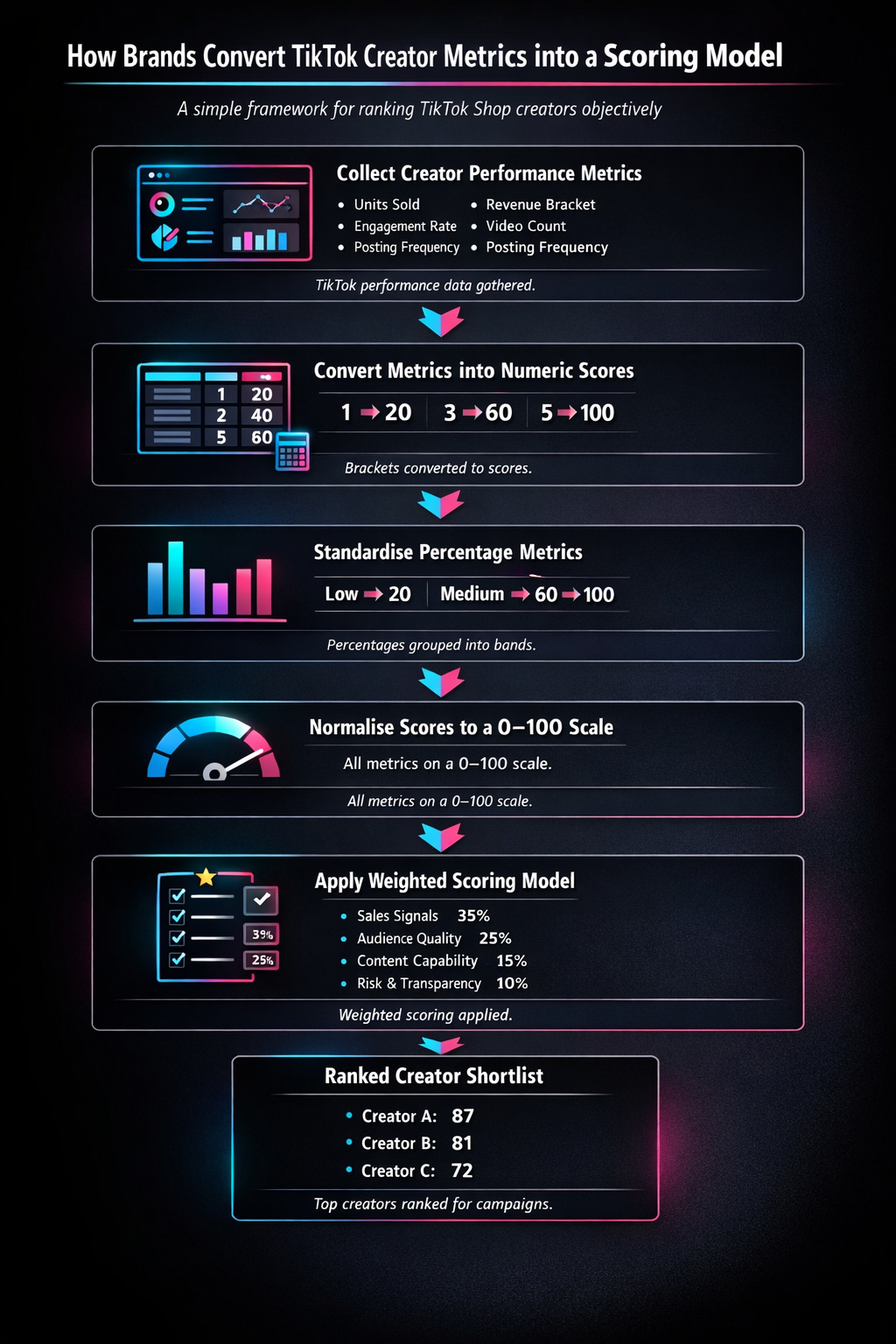
Once creator metrics have been converted into comparable scores, the next step is to determine how much influence each signal should have in the final evaluation. Not all metrics contribute equally to commercial performance, so a scoring model usually assigns different weights to different categories of indicators.
In most TikTok Shop campaigns, signals that reflect actual purchasing behaviour should carry the greatest importance. Metrics related to historical sales performance provide the clearest indication that a creator has already demonstrated the ability to convert viewers into buyers. As a result, sales-related indicators typically receive the highest weighting in the model.
A practical scoring framework typically distributes weights across several categories of creator performance. For example:
This structure ensures that indicators most closely tied to revenue receive the largest influence in the final score, while operational and qualitative factors still contribute to the overall evaluation.
Once each metric has been normalised and the weights are defined, the model can calculate a final score for each creator. The weighted score combines all performance indicators into a single value that allows creators to be ranked consistently.
Rather than judging creators individually, the goal of this score is to compare creators relative to one another. By ranking creators based on their weighted scores, brands can identify the strongest candidates, prioritise testing budgets, and build a repeatable system for selecting creators as their TikTok Shop campaigns scale.
Once the scoring formula is defined, the next step is to implement the framework in a practical tool. In most cases, brands build their creator evaluation models using Excel or Google Sheets, which allows teams to organise creator data, calculate scores automatically, and update rankings as new information becomes available.
A typical creator scorecard begins with a table where each row represents a creator and each column represents a performance indicator. These indicators can include the metrics available in the TikTok creator dashboard, such as engagement rate, revenue bracket, units sold bracket, or category GMV concentration. Additional operational information, such as commission expectations or posting frequency, can also be included to provide a more complete view of each creator.

A practical scorecard usually includes a combination of performance and operational indicators. Common input fields may include:
Each of these fields can then be converted into normalised scores based on the framework described earlier.
Once the input metrics and scoring formulas are in place, the spreadsheet can automatically calculate a final weighted score for each creator. This allows brands to sort creators by their total score and quickly identify the strongest candidates.
Using a scorecard also makes it easier to compare multiple creators side by side. Instead of relying on fragmented dashboard observations, decision-makers can evaluate creators within a consistent framework. Over time, this system can evolve into a repeatable internal database of creator performance, helping brands refine their selection process and scale TikTok Shop campaigns more efficiently.
As TikTok Shop campaigns grow, brands may need to evaluate dozens of potential creators for a single product launch. Using a structured scoring model helps streamline this process and ensures creators are assessed using consistent criteria.
Instead of reviewing creators individually, organise candidates within a single evaluation framework. This allows teams to compare creators using the same metrics and quickly identify those most suitable for testing.
A ranking model helps highlight the creators with the strongest performance signals. Brands can then focus their initial campaign budgets on the highest-scoring creators rather than testing partners randomly.
Over time, performance data from previous collaborations can improve the scoring framework. By adjusting weights or adding new indicators, brands can gradually build a more accurate system for identifying high-potential TikTok Shop creators.

Selecting TikTok creators based only on follower counts or viral videos often leads to inconsistent campaign results. As TikTok Shop campaigns become more competitive, brands need a more systematic way to evaluate potential partners.
A creator scoring model helps solve this challenge by converting multiple performance signals into a structured ranking system. By normalising metrics and applying weighted scoring, brands can compare creators objectively and identify those most likely to generate conversions.
Over time, this approach allows brands to build a repeatable process for creator selection. Instead of relying on subjective judgement, teams can use data-driven evaluation to prioritise testing budgets, refine creator partnerships, and scale TikTok Shop campaigns more efficiently.
Brands that want to accelerate this process can also work with experienced TikTok Shop operators. Contact eCOMMop to learn how our team helps brands identify high-performing creators, run structured testing campaigns, and scale TikTok Shop sales through data-driven creator partnerships.
Most agencies own a slice. The TikTok agency doesn't see your Amazon listing performance. Your Amazon manager doesn't know what's going viral on TikTok. Your Shopify CRO consultant doesn't see either.
We see all of it. Same team, same dashboards, same weekly review. When a TikTok video starts converting at 4×, we know to push that creative into Amazon Sponsored Brands and Shopify paid social — that same week. When Amazon shows a SKU running hot in Texas, we ramp creator seeding for that geo.
That's what "one engine" means in practice. One team. One dataset. One P&L view.