.svg)


Press-on nails have developed into a broad beauty category that now stretches from inexpensive everyday manicure sets to premium, design-led collections. Their appeal lies partly in convenience. Customers can change their nails at home, avoid salon appointments and experiment with different shapes or finishes without making a long-term commitment.
For TikTok Shop sellers, the category is attractive for another reason: the product is highly visual. Application, fit, removal and design can all be demonstrated in a short video. A clear before-and-after transformation can communicate the product’s value within seconds.
Visual appeal alone, however, does not guarantee a viable product. An elaborate set may attract views but still struggle if the shape is impractical, the fit is inconsistent or the selling price leaves insufficient margin for creator commission, fulfilment and returns.
The strongest initial range will usually combine familiar, wearable designs with a smaller selection of trend-led products. Current market research, retailer assortments and brand activity suggest that French tips, practical lengths, almond and squoval shapes, and improved sizing remain central to US demand.
Learn more about our product sourcing services and TikTok Shop management services or continue to read the article.
Press-on nails are still a relatively small part of the wider beauty industry, but the category has established a meaningful consumer base in the United States.
According to Grand View Research’s US press-on nail market analysis, the market generated an estimated US$192.1 million in revenue in 2024. It is forecast to reach US$269.3 million by 2030, representing an expected compound annual growth rate of 5.9% from 2025 to 2030.
The United States accounted for approximately 26% of global press-on nail revenue in 2024, making it one of the category’s most important national markets.
US press-on nail market indicatorEstimateMarket revenue in 2024US$192.1 millionForecast revenue in 2030US$269.3 millionForecast CAGR, 2025 to 20305.9%US share of global revenue in 202426%
The same Grand View Research report identifies plastic as the largest material segment, while gel is expected to record the fastest growth during the forecast period.
This creates room for two different product positions.
Plastic and ABS-based press-ons remain well suited to accessible, mass-market collections. Gel and soft-gel sets can support a more premium proposition centred on flexibility, a more natural finish and improved comfort.
Market growth should not be confused with easy market entry. Established brands already cover most mainstream shapes, colours and price points. At the same time, marketplace sellers compete aggressively through low prices and a constant flow of new designs.
A new brand therefore needs a clearer proposition than a large catalogue of generic nail sets. Differentiation may come from better sizing, a recognisable design identity, stronger packaging, a specific customer group or a more effective creator strategy.

There is no publicly available, audited database showing national US sales for every press-on nail product.
Any claim about the “best-selling” press-on nails should therefore be treated with care. A credible analysis has to draw on several signals, including market research, retailer purchase indicators, bestseller labels, review volume, price positioning and the repeated appearance of particular shapes or designs across major brands.
Retailer data is useful because it shows what customers are buying at a particular moment. It does not provide a complete measure of national market share.
The retailer figures used in this article were observed in July 2026. They should be read as current examples of broader demand patterns rather than permanent rankings.
The US press-on nail market is increasingly divided between two types of demand. The first is dependable, everyday demand for familiar styles such as French tips, nude colours and practical lengths. These products appeal to a broad audience and can remain in a collection across several seasons.
The second is faster-moving demand for chrome, magnetic, gradient and embellished finishes. These designs respond more closely to beauty trends and social-media content, giving brands new reasons to refresh their ranges throughout the year.
A successful collection should usually include both. Evergreen products support steady sales, while trend-led designs create discovery, seasonal relevance and stronger visual material for TikTok creators.
French tips remain one of the most dependable press-on nail styles because they work across many settings. They can be worn at work, at weddings or as an everyday manicure, and they are familiar enough for customers who are buying press-ons for the first time.
The category has also moved beyond the traditional white tip. Current variations include:
Nude, blush and sheer-pink sets serve a similar purpose. Their understated appearance makes them easier to wear repeatedly and less dependent on a particular season.
Ennio’s analysis of the best-selling press-on nail styles in the US identifies French tips and nude sets as core retail products, particularly in short and almond shapes. As a manufacturer and supplier, Ennio provides a useful industry perspective, although its observations should be understood as trade insight rather than independent retail sales data.
Current retailer activity supports the relevance of this category. In July 2026, several French-tip products from KISS and imPRESS displayed high recent purchase indicators on Target’s press-on nail category page. These included short squoval and medium almond designs across both entry-level and more decorative price points.
Target represents only one retailer, but its assortment illustrates why French, nude and sheer designs remain a sensible foundation for a new product range.
Chrome press-on nails have become an important part of trend-led collections. Silver, rose-gold, pearl and holographic finishes reflect light strongly, making them particularly effective in product photography and short-form video.
The appeal is partly visual. A chrome finish can look different as the hand moves, giving creators more opportunities to show texture and shine without relying on a complicated video concept.
Chrome also adapts well to several design directions:
Ennio’s US market overview notes that chrome and metallic finishes are often used in limited collections and seasonal assortments, particularly in almond and stiletto shapes.
For TikTok Shop sellers, chrome works best as a recognisable trend product rather than the whole collection. The finish can attract attention, while classic shapes and neutral colours make the design easier to wear.
Magnetic cat-eye nails use reflective pigment to create a shifting line or glow as the nail moves under light. Velvet-effect nails use a similar visual principle to create a softer, fabric-like shimmer.
These finishes can give press-ons a more premium appearance because the effect resembles a salon gel manicure. They are especially suited to autumn, winter and evening collections, with jewel tones, deep brown, burgundy, navy and emerald among the most natural colour directions.
Ennio identifies cat-eye and velvet finishes as growing trend categories in US press-on nail assortments, particularly when supported by influencer content.
From a sourcing perspective, these finishes require more care than basic solid colours. Ennio notes that chrome, cat-eye and three-dimensional finishes add production steps and can increase defect risk. Brands should therefore balance visual complexity against order volume, quality tolerance and target retail price.
Ombré and gradient press-ons occupy the space between classic and highly decorative designs.
Common versions include:
These designs provide more visual detail than a solid colour while remaining suitable for everyday wear. They can also move between bridal, spring, summer and occasion-based collections without looking overly seasonal.
Ennio’s US market article highlights nude-to-white fades, pastel ombrés and gradient French designs as commercially relevant styles because they combine subtle nail art with broad wearability.
For a new seller, gradient designs may be easier to scale than heavily embellished products. They create a distinctive look while avoiding loose charms, protruding decorations and some of the quality-control issues associated with complex nail art.
Three-dimensional press-on nails may include rhinestones, pearls, sculpted gel, bows, charms or textured details. These designs can produce strong shelf impact and are well suited to event, holiday and creator-led collections.
Their commercial role differs from that of French or nude sets. They are more likely to be purchased for:
The most wearable sets often combine one or two embellished accent nails with simpler nails in the same colour family. This gives the customer some visual drama without making every nail difficult to wear.
Ennio observes that accent-based 3D sets can work well in seasonal assortments because they create a premium focal point while retaining a relatively neutral base.
For sellers, the trade-off is higher production complexity. Stones and charms must remain securely attached, surface finishes must survive shipping, and the product photography must accurately show the final scale and texture.
These designs are therefore better suited to limited capsules than to the entire core range.

Colour and finish attract attention, but shape and length often determine whether the customer can wear the product comfortably.
The most commercially useful shape range includes:
These shapes provide a natural appearance and are suitable for customers who prefer a low-maintenance manicure. They are especially relevant to first-time users and buyers who find standard press-ons too long.
Squoval combines a flatter top with softened corners, giving it a structured but practical look. Square nails offer a stronger, more defined silhouette and work well with French tips, solid colours and graphic designs.
Almond nails taper towards a rounded point. The shape looks elegant on camera and can make the fingers appear longer, while remaining more practical than stiletto styles. It works particularly well with French, chrome, gradient and cat-eye finishes.
Coffin nails taper along the sides and finish with a flat tip. They create a bolder silhouette and are frequently paired with metallic, jeweled and highly decorative designs. Short coffin styles can broaden wearability, while long coffin nails are better suited to statement collections.
Stiletto nails have a sharper point and create the most dramatic look. They can perform strongly in fashion-led content but have narrower everyday appeal.
Ennio’s sourcing guide notes that almond, coffin, square, round and stiletto are common manufacturing shapes, generally offered across short, medium and long lengths. It also stresses that geometry affects retention, breakage and fit, not only appearance.
Retailers therefore need more than a variety of colours. A commercially balanced range should allow customers to choose between practical short shapes, versatile medium almond styles and a smaller selection of longer statement nails.
For a first launch, the most balanced assortment would usually combine short round or squoval, medium almond and one coffin option. This gives the brand enough variety to test customer preferences without creating excessive inventory across too many shapes.
The US market supports several price tiers.
Value products generally compete through accessibility, simple designs and established brand recognition. Mainstream products add stronger packaging, broader sizing or more fashionable finishes. Premium products rely on distinctive design, perceived durability, creator visibility and a more polished brand identity.
Current retail pricing suggests the following broad structure:
Product positionIndicative retail rangeEntry-level setsAround US$4.99 to US$8.99Mainstream branded setsAround US$8.99 to US$13.99Premium design-led setsAround US$14 to US$22
At Target, KISS and imPRESS products commonly appeared between US$4.99 and US$11.99, while more design-led brands occupied higher price points. Ulta’s press-on nail assortment also shows premium products from brands such as Glamnetic extending towards US$18 to US$22.
These prices should be treated as retailer examples rather than an official market standard. Pack size, design complexity, adhesive format, brand strength and promotional activity all affect the final selling price.
For TikTok Shop sellers, the most important number is the contribution margin after all operating costs.
Those costs may include:
A product that appears inexpensive at factory level may become difficult to scale after these costs are included.
The US market includes mass-retail leaders, digital-first beauty brands and specialist nail companies.
Grand View Research identifies KISS Products, Dashing Diva, Static Nails, Clutch Nails, Red Aspen and Glamnetic among the category’s notable participants.
KISS and its imPRESS line hold a particularly broad position. Their assortment covers classic French tips, solid colours, short everyday sets, medium almond shapes and heavily decorated statement designs. This range allows the company to serve several customer groups without depending on one trend.
Glamnetic occupies a more premium and design-led position. Its sets are often visually distinctive, which suits creator demonstrations and social commerce. Dashing Diva and Static Nails also compete around finish, design and at-home salon positioning.
Olive & June illustrates the wider commercial value of home nail care. According to Helen of Troy’s acquisition announcement, the company agreed to acquire Olive & June for a total purchase price of US$240 million, including a potential US$15 million earnout.
Helen of Troy expected Olive & June to generate approximately US$92 million in net sales in 2024. That figure covers the brand’s wider nail-care business, not press-on nails alone.
The acquisition nevertheless shows that large consumer-product groups see strategic value in brands built around at-home nail care, education and direct consumer engagement.
A new TikTok Shop seller is unlikely to compete with these brands through product breadth. A more realistic approach is to begin with a narrower promise, such as inclusive sizing, extra-short everyday nails, trend-led soft-gel sets or creator-designed capsule collections.

Press-on nails are well suited to social commerce because the product can be understood quickly through visual demonstration.
A creator can show the full customer journey in one short video:
This gives press-on nails an advantage over products whose benefits are harder to demonstrate. The transformation is immediate, and buyers can judge the shape, length, finish and overall effect before visiting the product page.
TikTok’s own commerce data also points to the growing role of product discovery on the platform. According to TikTok Shop’s US shopping report, US TikTok Shop sales increased by 120% year over year during the measured period in 2025. TikTok also reported that 83% of TikTok Shop shoppers discovered a new product on the platform.
During the four-day Black Friday and Cyber Monday campaign in 2025, TikTok said US TikTok Shop sales exceeded US$500 million. The platform also reported that sellers and brands hosting livestreams recorded 84% sales growth compared with the previous year’s campaign.
These are platform-reported figures rather than independent market measurements. Even so, they show why visually demonstrable beauty products are attracting interest from brands and sellers.
For press-on nails, the most useful TikTok content does more than display a finished manicure. It addresses the practical questions that often determine whether someone completes a purchase.
Strong content angles include:
Fit and sizing deserve particular attention. A customer may like the design but still hesitate if the set appears unlikely to fit their nail shape. Content that shows the size range, thumb width and curvature can remove this uncertainty before purchase.
A new seller should resist the temptation to build the entire range around highly decorative trends.
Trend-led designs can generate attention, but everyday styles are more likely to support consistent demand. A balanced collection can combine an evergreen core with smaller fashion-led releases.
The strongest initial assortment should include designs that work across several occasions and customer groups.
Recommended core products include:
These products are easier to position around everyday use, work, weddings and first-time press-on purchases.
French designs are particularly useful because they can be refreshed without abandoning a familiar visual language. A brand can develop classic white tips alongside coloured French, chrome French, glitter French and micro-French collections.
Trend-led products give creators more material for videos and limited campaigns.
Potential 2026 directions include:
Beauty publications including Allure and Vogue have highlighted updated French styles, texture, embellishment and more refined interpretations of familiar nail designs among the trends shaping 2026.
Editorial forecasts are not sales data. They are more useful for identifying creative directions than predicting which exact products will sell.
Sellers should therefore test fashion-led products in smaller quantities and use creator response, add-to-cart rates and sell-through data before increasing inventory.
Long coffin nails, fruit designs, sculpted glass effects and heavily jeweled sets can create strong visual content. They also carry greater inventory risk.
These products may have:
They are better suited to seasonal drops, creator collaborations or limited collections.
As a starting framework, a seller might allocate:
This is a strategic product-planning suggestion rather than an industry benchmark.
The right sourcing model depends on how quickly the seller wants to launch and how much differentiation the brand requires.
Ready-stock products use existing supplier designs and packaging structures.
This is usually the fastest route to market. It can work well for testing shapes, price points and customer demand before committing to a larger custom order.
The main weakness is limited differentiation. The same design may appear under several brand names or on multiple marketplaces.
A semi-custom arrangement normally uses an existing mould while allowing the seller to change the colour, finish, artwork, packaging and included accessories.
This provides more brand control without the development cost of creating a completely new product.
For many first-time sellers, this offers a practical balance between speed and differentiation.
A fully custom product may involve new shapes, curvature, thickness, sizing and packaging.
This route gives the brand greater control over fit and design. It is also more expensive and normally requires a higher minimum order quantity.
Custom development makes the most sense when the seller has identified a specific gap, such as:
China has developed a significant production ecosystem for handmade press-on nails.
WIRED reported that one wholesaler estimated Donghai County produces approximately 70% of China’s press-on nails, with output of around 400,000 sets per day.
These figures came from a local supplier and should not be treated as official production statistics. The same report found elaborate handmade sets selling locally for less than US$2, but this should not be interpreted as a guaranteed factory cost or profit margin.
The final commercial cost may also include:
The apparent gap between a Chinese wholesale price and a US retail price can narrow considerably once these costs are included.
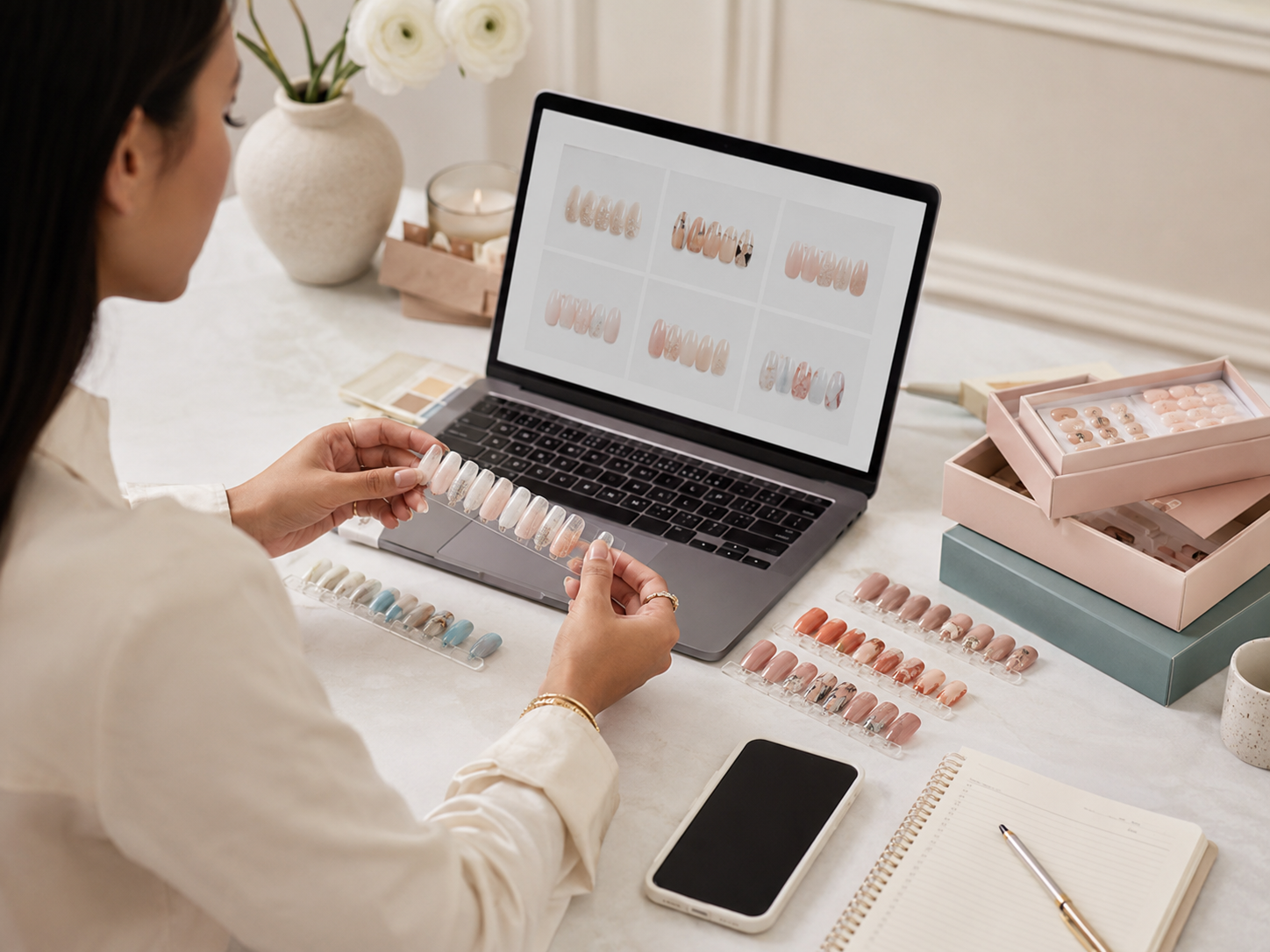
A supplier should be assessed on more than design variety.
The first step is to request full product specifications, including:
Fit testing is particularly important. Samples should be tested by several people with different nail-bed widths and curvatures.
The review should consider:
Quality control should also check colour consistency, missing sizes, duplicate sizes, print alignment, sharp edges, packaging errors and barcode accuracy.
A visually attractive product can still create poor reviews if sizing is inconsistent or one part of the kit fails.
Press-on nail sellers also need to consider cosmetic, adhesive and import requirements.
The US Food and Drug Administration states that nail products used at home or in salons are generally regulated as cosmetics. Products sold in the United States must be safe when used as directed and must carry appropriate warnings where necessary.
Depending on the product, packaging may need to include:
Claims must also be accurate. Sellers should avoid unsupported promises such as guaranteed wear periods, completely damage-free removal or claims about materials that cannot be verified.
Adhesive requires additional attention. TikTok Shop’s US dangerous-goods guidance identifies adhesives and glue among the products that may require documentation.
Sellers may need to obtain a Safety Data Sheet or Material Safety Data Sheet from the manufacturer. This documentation helps determine whether the adhesive is subject to specific storage, shipping or labelling requirements.
Brands should also avoid designs that copy protected logos, characters or recognised designer patterns without permission.
Product compliance depends on the exact construction, included adhesive and sales claims. Sellers should obtain professional regulatory and customs advice before importing or launching a product.
A sensible starter collection should test several customer preferences without spreading inventory too thinly.
A practical first range could include:
This range tests several important variables:
The seller can then expand the strongest combinations rather than building a large catalogue before demand is understood.
A high-performing TikTok Shop product also depends on more than sourcing. Product listings, creator content, affiliate commission, inventory planning and fulfilment all affect whether the product can scale.
eCOMMop helps eCommerce brands evaluate product opportunities, source suppliers, optimize TikTok Shop listings and build creator-led sales strategies.
Learn more about our product sourcing services and TikTok Shop management services.
Most agencies own a slice. The TikTok agency doesn't see your Amazon listing performance. Your Amazon manager doesn't know what's going viral on TikTok. Your Shopify CRO consultant doesn't see either.
We see all of it. Same team, same dashboards, same weekly review. When a TikTok video starts converting at 4×, we know to push that creative into Amazon Sponsored Brands and Shopify paid social — that same week. When Amazon shows a SKU running hot in Texas, we ramp creator seeding for that geo.
That's what "one engine" means in practice. One team. One dataset. One P&L view.