.svg)


TikTok Shop management does not have a standard price.
A brand may pay a monthly fee for someone to maintain its store, or it may commission a wider operating programme covering product listings, creators, affiliate sales, advertising, customer service and fulfilment. These arrangements can look similar on a proposal while involving very different levels of work.
The management fee is also only one part of the budget. TikTok Shop referral fees, creator commissions, samples, paid content, advertising, shipping and returns all affect the final cost of selling through the platform.
This guide explains the major TikTok Shop costs in the United States, how different management models work and what brands should check before comparing quotations.
There is no official TikTok Shop management rate or independently verified industry price list. Agencies, consultants and internal teams set their own fees according to the work involved.
A limited engagement may cover shop setup, product listings and routine administration. A broader programme may include creator recruitment, affiliate management, content production, GMV Max advertising, livestream support and daily commercial decisions.
For this reason, brands should compare scope, output and accountability, rather than looking only at the monthly retainer.
A complete monthly TikTok Shop budget may include:
A quotation that excludes most of these items may appear inexpensive while leaving the brand responsible for the most labour-intensive parts of the operation.
TikTok Shop management can cover four broad areas:
The initial work may include:
This stage can be offered as a one-off project or included in a longer management agreement.
Ongoing management may cover:
These tasks often determine whether a shop remains operationally healthy after launch.
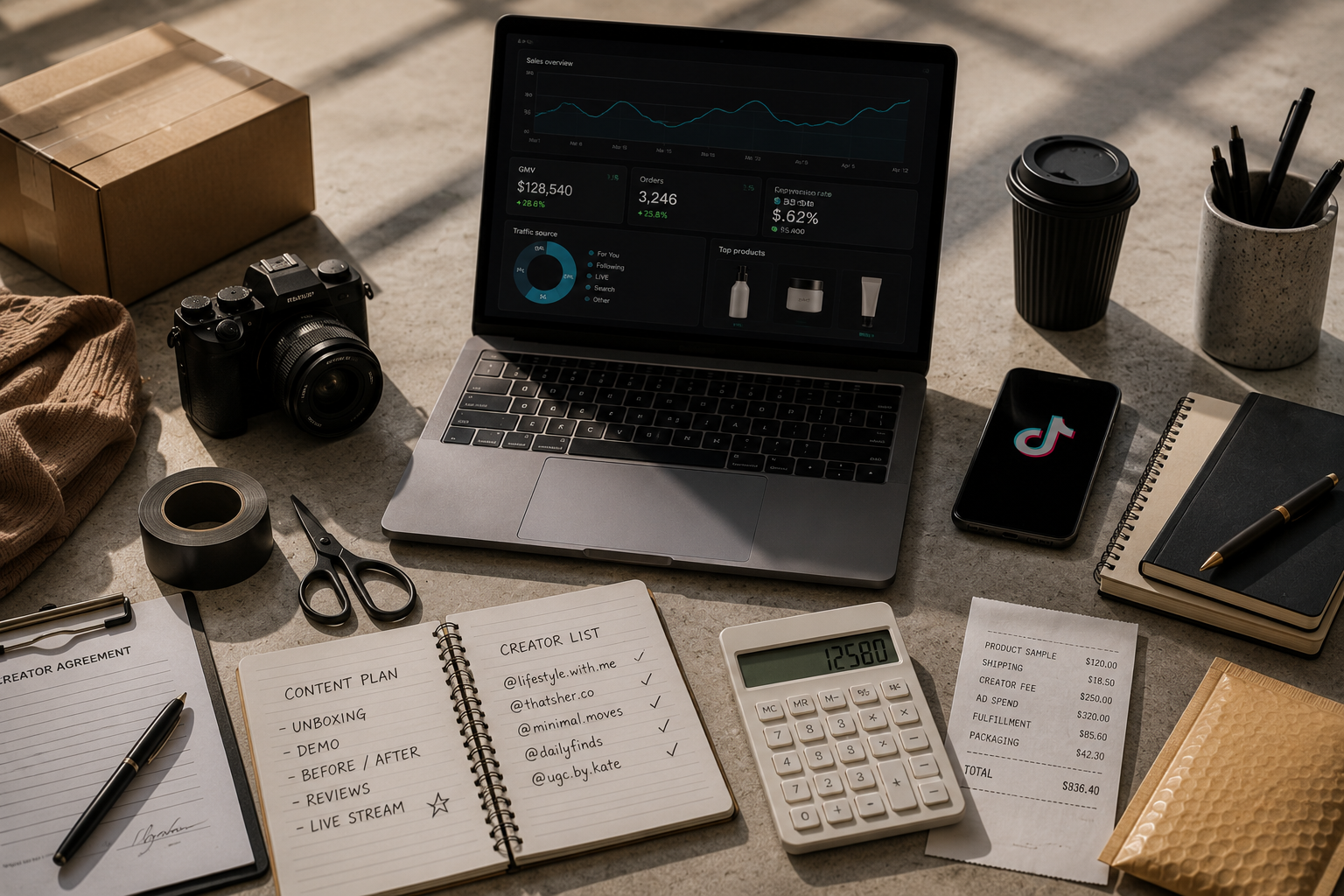
TikTok Shop Affiliate allows sellers to work with creators who earn commission when their content generates sales. TikTok’s current US guidance says qualified shops can set a universal commission rate for affiliate products, while targeted collaborations allow sellers to choose products, commission, samples and deliverables.
Creator management may therefore include:
The workload can grow quickly when a brand works with dozens or hundreds of smaller creators.
A wider engagement may also include:
TikTok states that GMV Max has been the default supported campaign structure for TikTok Shop Ads since July 2025. Its Product GMV Max system uses available shop, organic and affiliate creative assets to optimise total channel return.
A quotation covering only shop maintenance should not be compared directly with one that includes creators, content and advertising.
The brand pays a fixed fee for an agreed monthly scope.
A retainer gives both parties a predictable budget, but the agreement should define what is included. Important details include:
The main risk is paying for broad “management” without a clear definition of output.
The management provider receives a percentage of sales.
This can reduce the brand’s fixed cost and connect compensation with revenue. It can also create disputes if the contract does not define eligible sales precisely.
The agreement should clarify:
A brand already generating sales should also establish a baseline. Otherwise, it may pay a performance fee on revenue that existed before the engagement.
A hybrid agreement combines a fixed retainer with a smaller percentage of revenue or a performance bonus.
For example:
This structure can provide enough fixed funding for daily operations while preserving a performance incentive.
A one-off project may cover:
This model suits businesses that already have staff to manage the shop after launch.
Management fees are separate from the fees collected by TikTok.
TikTok Shop’s official US fee table currently shows a 6% referral fee for most product categories, with selected jewellery and pre-owned categories charged at different rates. The exact fee depends on the product category and should be confirmed in Seller Center before preparing a forecast.
At a 6% referral rate:
Temporary incentives may reduce the rate for selected sellers, but they should not be treated as permanent economics.

When an order is refunded, TikTok generally returns the original referral fee after deducting a Refund Administration Fee.
Under TikTok Shop’s published US rules, the administration fee equals 20% of the original referral fee and is calculated at SKU level.
Returns can also create costs through:
TikTok’s return policies have been updated during 2026 and allocate shipping or refund responsibilities differently according to the reason for the return. Sellers should therefore model the cost using their own category, fulfilment method and return rate.
A provider that improves listings, product claims and fulfilment accuracy may reduce costs that never appear in the management retainer.
Affiliate commission is set by the seller. There is no universal rate suitable for every product.
TikTok allows shops to create open or targeted collaborations, select products and set commission levels. The platform also provides a 30-day protection period in certain cases when a commission is reduced for creators already promoting a product.
The appropriate commission depends on:
Consider a shop generating US$50,000 in monthly GMV. If half of its sales are attributed to affiliate creators and the average commission is 12%, the monthly affiliate cost would be:
US$50,000 × 50% × 12% = US$3,000
This sits alongside referral fees, content, ads, fulfilment and management.
Some creators will work for a free sample and commission. Others require a guaranteed payment.
TikTok Shop formally supports Flat Fee + Commission Invite collaborations, where the seller agrees to a flat payment for a shoppable video while also offering sales commission.
A creator budget may include:
The distinction between creator types matters.
An affiliate is mainly compensated through sales. A UGC creator is paid to produce an asset. An influencer is also selling access to an audience. One person may perform more than one of these roles, but the commercial terms should state exactly what the brand receives.
Advertising spend is normally separate from the shop management fee.
TikTok’s Product GMV Max system combines paid delivery with organic and affiliate content. TikTok states that the GMV Max dashboard attributes all orders for advertised products to the campaign, including orders originating from organic content and affiliates.
This creates an important contractual issue.
A provider charging a percentage of “GMV Max revenue” may be paid on sales that were influenced by:
The contract should therefore specify whether performance compensation is based on total GMV, paid incremental GMV, creator-attributed revenue or settled revenue above an agreed baseline.
TikTok recommends setting Product GMV Max budgets according to historical performance and warns that overly high ROI targets may restrict delivery. For gross-revenue optimisation campaigns, its guidance recommends a daily budget of at least ten times the target purchase CPA. A platform minimum is not the same as a commercially useful testing budget.
US sellers can use:
TikTok’s shipping requirements confirm that Fulfilled by TikTok stores inventory and handles fulfilment on the seller’s behalf.
FBT charges depend on product size, weight and the number of units shipped in an order. TikTok introduced a new US FBT rate card from January 12, 2026 and continues to publish updated fees and incentives. Sellers should check the latest official rate card instead of relying on a fixed historical figure.
Fulfilment expenses may include:
These costs can vary more than the management fee when order volume increases.
Hiring a dedicated TikTok Shop Manager gives the brand direct control, but it also creates a substantial fixed cost.
Recent US job postings indicate that TikTok Shop Manager and Social Commerce Manager roles commonly offer base salaries of approximately:
Overall, a full-time US TikTok Shop Manager may cost roughly US$80,000 to US$150,000 a year in base salary, depending on experience, location and the scope of the role.
An agency may be more economical when the brand needs TikTok Shop operations, creator management, content and paid media without building a full internal team. Hiring in-house may become more cost-effective once the channel is large enough to support a dedicated operator and the company already has content, advertising and customer-service resources.
A useful monthly formula is:
Total TikTok Shop operating cost =
management
Cost of goods should then be deducted when calculating contribution margin and profitability.
The following example is a planning model, not an industry average.
Monthly cost itemIllustrative amountManagementUS$6,000Samples and creator postageUS$2,000Flat creator and UGC feesUS$2,500TikTok Shop adsUS$8,000Paid-media managementUS$1,200Affiliate commissionUS$4,500TikTok referral feeUS$4,500Total before product and fulfilment costsUS$28,700
This model assumes US$75,000 in monthly GMV, half attributed to affiliates at a 12% average commission, and a 6% TikTok referral fee.
Its purpose is to show why a US$6,000 management fee does not mean the channel costs only US$6,000.
Before comparing providers, ask for a written breakdown covering:
The lowest quotation can become expensive when most operating work remains outside the agreement.
Outsourcing may make sense when a brand has product demand but lacks the time or specialist knowledge to manage TikTok Shop internally.
The strongest case usually appears when the provider can connect several functions: product listings, creator recruitment, affiliate economics, content, ads and daily operations.
A management partner should ultimately be judged by more than GMV. The brand should also track contribution margin, return rate, creator productivity, repeat purchasing, content output and operational stability.
eCOMMop helps brands operate TikTok Shop across product listings, creator partnerships, content, advertising and commercial growth.
Learn more about our TikTok Shop management services.
Most agencies own a slice. The TikTok agency doesn't see your Amazon listing performance. Your Amazon manager doesn't know what's going viral on TikTok. Your Shopify CRO consultant doesn't see either.
We see all of it. Same team, same dashboards, same weekly review. When a TikTok video starts converting at 4×, we know to push that creative into Amazon Sponsored Brands and Shopify paid social — that same week. When Amazon shows a SKU running hot in Texas, we ramp creator seeding for that geo.
That's what "one engine" means in practice. One team. One dataset. One P&L view.