.svg)


The creator economy is entering a new phase. For years, creators primarily monetized through sponsorships, advertising revenue, affiliate partnerships, and brand collaborations. Today, more creators are exploring a different opportunity: building products of their own.
The opportunity is significant. Goldman Sachs estimates the creator economy could grow from approximately US$250 billion to nearly US$480 billion by 2027. As audiences increasingly trust creators as experts, educators, entertainers, and tastemakers, owned products are becoming a natural extension of creator-led businesses.
Yet building a product brand is very different from building an audience.
A creator can have millions of followers and still struggle with supplier selection, product development, manufacturing, quality control, packaging, logistics and fulfilment. The skills that help someone build influence are not always the same skills required to build a reliable product operation.
This is the gap many creator brands still need to solve. Audience demand creates the opportunity, but operational execution determines whether a product becomes a long-term business or a short-lived launch.
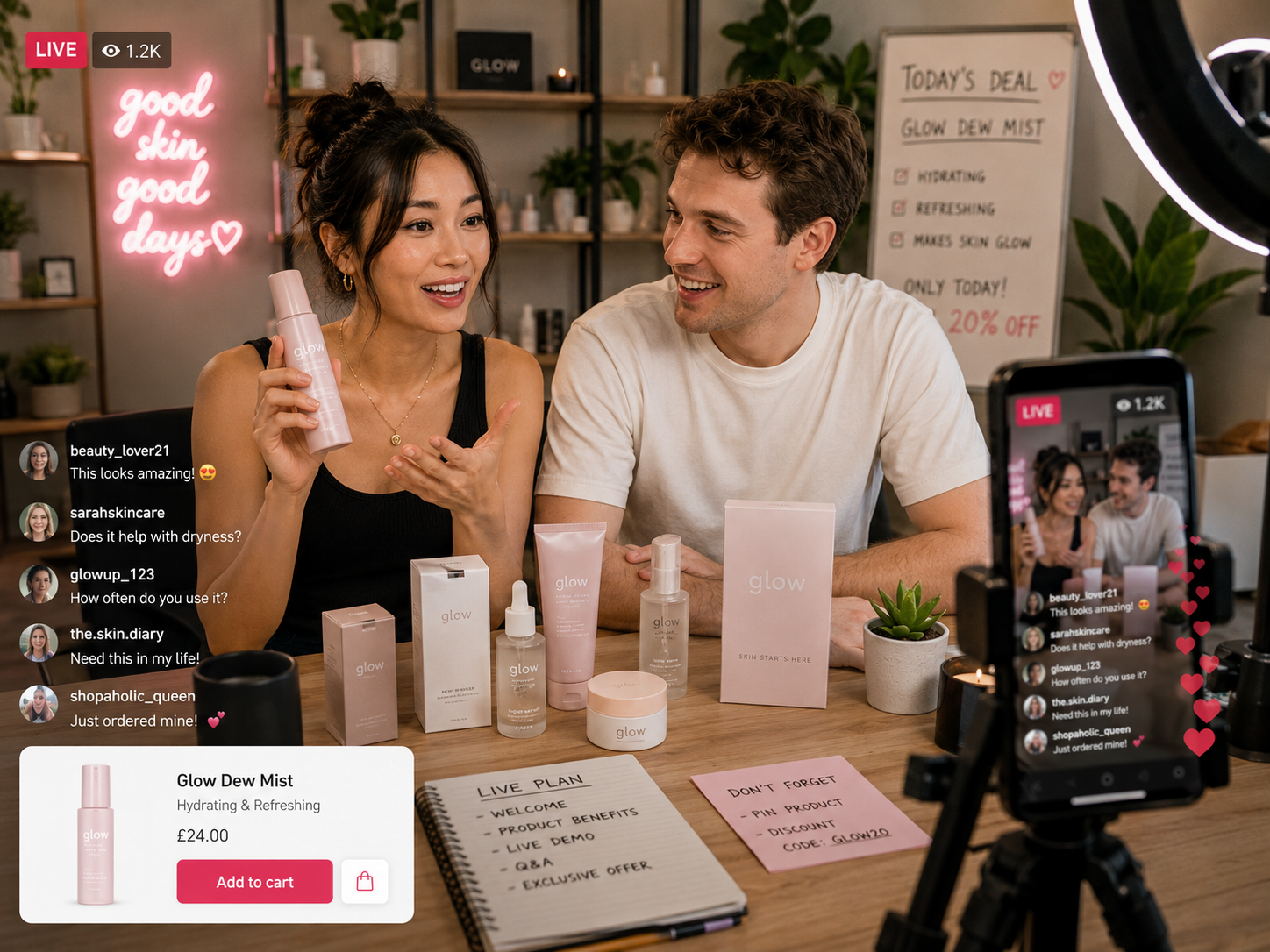
For a creator with a large audience, launching a product can look obvious from the outside. There is attention, there is trust, there is daily interaction, and in many cases there are already people asking where to buy something, what product is being used, or when the creator will finally release something of their own.
That is why creator products sound simple in theory. If millions of people follow someone, surely a percentage of them would buy the right product.
In some cases, that is true. But it is also the reason many creator launches get underestimated. Audience is a powerful advantage, but it does not remove the operational reality of building, sourcing, producing and delivering a physical product.
A creator can have the demand and still not have the infrastructure.
This is the gap many large creators and their teams are sitting on today. They have distribution, but not always a product engine behind it. They understand their audience better than most traditional brands ever will, but that does not automatically translate into supplier selection, sampling, packaging, quality control, shipping, landed cost, inventory planning or fulfilment.
That is usually where the conversation becomes more serious.
A brand deal is clean. The creator promotes the product, the brand handles the rest, and the operational risk belongs to someone else.
An owned product is different.
The product carries the creator's name, taste and reputation. If the quality is poor, if the packaging feels cheap, if the order arrives late, or if customers feel disappointed, the audience does not blame a distant supplier. They blame the creator.
For creators, product quality is not only an operational issue. It is a trust issue.
That trust has measurable commercial value. Shopify cites research showing that 45% of consumers are willing to purchase products promoted by creators, while 73% report greater trust when creators demonstrate genuine expertise and product knowledge.
When a creator launches a product, the audience is often buying more than an item. They are buying confidence in the creator's judgment and standards.
The default path for many creators has been merch. It is familiar, easy to understand and relatively simple to launch. A logo on a hoodie, a cap, a mug or a basic accessory can work when the community is strong enough.
But merch is often the smallest version of the opportunity.
The shift is already visible across creator commerce. Brands such as Feastables, Prime and Chamberlain Coffee have demonstrated that audiences are willing to follow creators into entirely new product categories when the offering feels authentic to the creator's content and community.
Research highlighted by Vogue Business found that consumers are now slightly more likely to purchase products created by creators than products merely recommended by them. That distinction matters because it suggests audiences increasingly view creators as brand builders rather than only marketing channels.
For many creators, the strongest product is not the one with the biggest logo. It is the one that feels natural coming from them.
A fitness creator does not necessarily need to start with supplements. Depending on the audience, the better first product could be training gear, recovery accessories, a gym bag, grip equipment, water bottles, apparel or products that fit into the audience's existing routine.
A beauty creator does not necessarily need to start with cosmetics, especially when regulation, testing and claims can make the category more complex. The first product might be a mirror, organiser, brush cleaner, travel case, applicator, lighting accessory or beauty tool.
A food creator does not need to manufacture food on day one. The smarter move may be kitchen tools, prep products, storage solutions, cutting boards, utensils, aprons or cooking kits that naturally fit the way the audience already cooks.
The point is not to force a product onto an audience.
The point is to notice where the audience already sees the creator as credible.
This is where many creator brands should begin. Not with "what can we sell?" but with "what would make sense for this audience to buy from this person?"
That question sounds simple, but it prevents a lot of bad launches. A creator product should not feel like an ecommerce product with a famous face attached to it. It should feel like a natural extension of the creator's world.

Large creators usually have more product signals than they realise. Comments, DMs, repeated questions, inside jokes, routines, complaints and audience habits can all point toward product opportunities.
In that sense, creators possess a form of market research that many traditional brands would pay heavily to access.
But signals are not the same as decisions.
A comment saying "you should sell this" is not enough. A viral moment is not enough. A product that looks good on TikTok is not enough.
Before a product becomes inventory, someone has to evaluate whether it can realistically become a business.
Before committing to production, creator teams should answer several practical questions:
That is the part that often slows teams down.
Not because the opportunity is weak, but because the backend is unclear.
This is also where the language of product starts to matter. A team may need to decide whether the launch should be white label, private label, ODM or OEM.
Each route comes with different trade-offs in speed, control, customisation, cost and risk.
White label may be useful when speed and validation matter. Private label can give the creator more ownership over branding, packaging and positioning without building a product completely from scratch. ODM can work when a factory already has product development capability and the creator wants modifications around an existing design. OEM becomes relevant when the product needs to be built around a more specific design, material, function or specification.
None of this needs to become the creator's daily job.
But it does need to be understood by someone on the team before money is committed.
A creator should not have to become a sourcing operator. An agent should not have to become a factory manager. But the product still needs someone thinking through these trade-offs clearly.

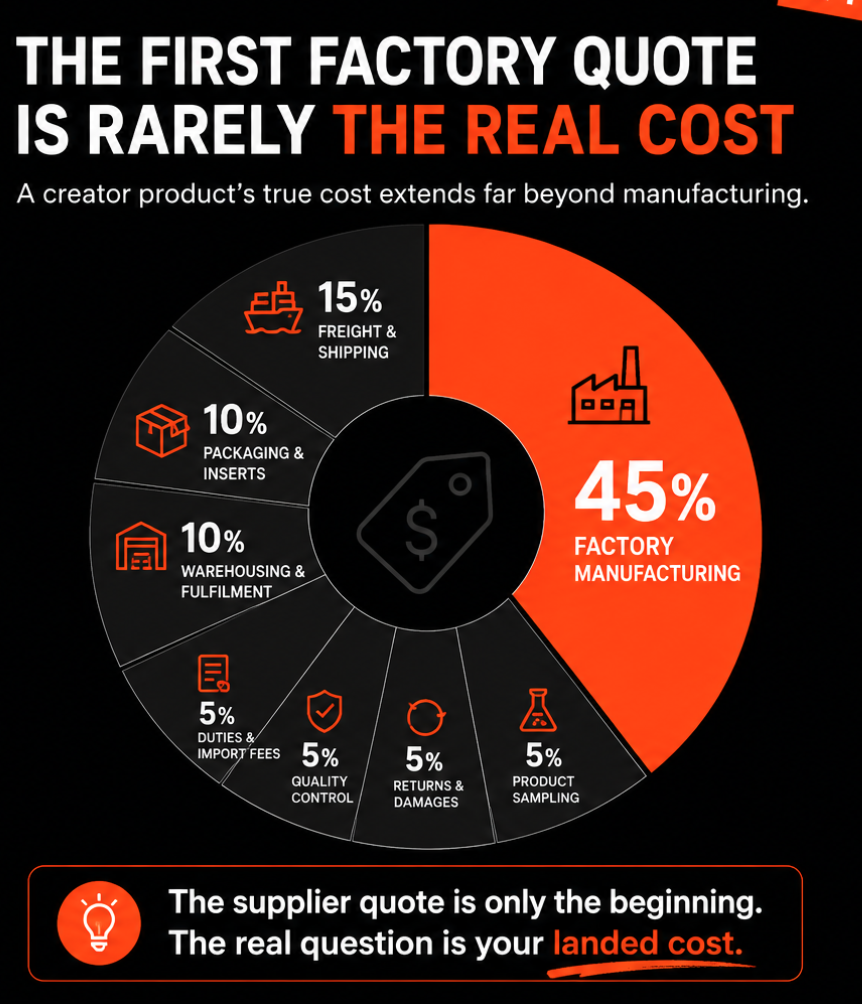
One of the easiest mistakes in a first product launch is looking at a supplier's unit price and treating it as the margin.
A factory quote can make a product look attractive very quickly, particularly when a creator is comparing multiple product ideas or trying to estimate potential revenue. But the quoted unit price is only one part of the equation. The real question is landed cost, and that number can change significantly once packaging, inserts, labelling, sample revisions, testing, freight, duties, DDP shipping, warehousing, fulfilment fees, returns, damaged inventory and delays are included.
This is where many creator teams get caught. A product that appears highly profitable during the quotation stage can become far less attractive once the full path to the customer is calculated. In some cases, a low quote may also hide weaker materials, inconsistent finishing, unclear packaging standards, communication issues or quality risks that only become visible later in the process.
For creators, the challenge is that these costs are often invisible to the audience but highly visible to the business. Customers see the final product and retail price. The team behind the launch has to understand everything that happens between the factory and the customer's doorstep.
When evaluating a product opportunity, it is important to look beyond the factory quotation and consider the wider cost structure that supports a successful launch.
A product that costs $8 to manufacture may ultimately cost significantly more before it reaches a customer's doorstep. This is why experienced product teams focus on total landed cost rather than unit cost alone. The goal is not simply to find a supplier with an attractive quote. The goal is to understand what the product will genuinely cost by the time it is ready to sell, ship and support.
This is also why transparency matters so much in creator commerce. Teams need a realistic view of what is known, what remains uncertain and what still needs to be tested before larger commitments are made. Sometimes the right decision is to move quickly. Sometimes it is to spend more time validating samples. Occasionally, the right decision is to avoid the product altogether because the numbers, timeline or quality risks do not justify the opportunity.
That honesty is often more valuable than optimism.
There is a reason many agents and talent managers become cautious when product opportunities arise. They can clearly see the upside of building an owned product, but they can also see the operational complexity that follows.
A creator product launch can quickly expand beyond the initial idea. What begins as a product concept often becomes a series of supplier conversations, sample revisions, packaging approvals, MOQ negotiations, production follow-ups, shipping coordination and fulfilment planning. If the team is not prepared for those responsibilities, what looked like a straightforward opportunity can become a distraction from the creator's core business.
That does not mean creators should avoid launching products. It simply means the operational side of the business should be treated as a genuine function rather than an afterthought.
The creator should remain focused on the audience, the story behind the product and the overall brand direction. Managers and agents should focus on protecting the creator's reputation while evaluating commercial opportunities and business risks. The operational layer should handle the path from concept to sample, from sample to production and from production to launch.
As creator brands grow, this separation becomes increasingly important. A creator's time is often better spent creating content, building community and shaping product vision than chasing factories, comparing freight quotes or managing quality issues.
For larger creators and their teams, this is where the idea of a long-term sourcing partner becomes more valuable than a one-time supplier search.
A one-time supplier search may help identify a factory, but a product business requires much more than a list of manufacturers. It requires product filtering, supplier benchmarking, sample coordination, MOQ negotiation, packaging development, production monitoring, quality control and shipping management. When multiple suppliers are involved, it may also require order consolidation, inventory coordination and cost visibility across the supply chain.
This is where many creator teams discover that product sourcing is not a single task. It is an ongoing capability that influences every stage of the product lifecycle.
Whether a creator chooses white label, private label, ODM or OEM manufacturing, the quality of the sourcing process often determines the quality of the final outcome. Strong sourcing is not simply about finding the lowest quote. It is about balancing quality, reliability, communication, scalability and commercial viability.
The best supplier is rarely the cheapest supplier. More often, it is the supplier that can consistently deliver the experience the audience expects.
As creator-led brands continue to expand, sourcing decisions increasingly become brand decisions. The factory producing the product may never appear in the marketing materials, but its work will ultimately shape how customers perceive the creator's standards.
In practice, successful creator brands often start to resemble product businesses as much as media businesses. While creators may not need a large in-house operations department from day one, they often benefit from having access to a specialised product function that supports decision-making behind the scenes.
That function may include supplier identification, product sourcing, sample management, packaging development, production oversight, quality control, logistics coordination and margin analysis. The objective is not to take control away from the creator. Rather, it is to provide better information before important decisions are made.
The best version of this role is rarely visible to the audience. It does not need to become part of the marketing story or the creator's public identity. Instead, it quietly reduces uncertainty, identifies potential problems earlier and creates a clearer path from product concept to customer delivery.
When this function works well, creators can remain focused on building their community and refining products that genuinely fit their audience. The operational side exists to support that vision rather than compete with it.
As creator commerce continues to mature, this distinction becomes increasingly important. The creators who build sustainable product businesses are rarely the ones with the most ideas. More often, they are the ones with the strongest systems supporting those ideas and the discipline to make informed decisions before committing to a launch.
There is often pressure around creator product launches to make the first release feel significant. A large audience can create expectations for a major announcement, a large inventory commitment or ambitious sales targets. While that approach can work, it can also introduce unnecessary risk when a product has not yet been properly validated.
A more sustainable first launch is usually designed to learn rather than maximise short-term revenue.
The objective is not simply to sell inventory. It is to answer a series of important questions that will influence future product decisions. Will the audience actually buy this product? Does it feel authentic coming from the creator? Is the price point realistic? Does the packaging reinforce the brand? Can the product be produced consistently? Does the margin remain attractive after landed costs are calculated? Can fulfilment handle the order volume?
These questions turn a product idea into a business decision.
Before increasing order volumes or expanding into additional products, creator teams should look for several indicators that the initial launch is working.
Low MOQs can be valuable because they allow teams to test demand without overcommitting capital. Sampling remains important because it reveals what a supplier can actually deliver rather than what was promised during early conversations. Quality control also matters because a bulk order should not become the first time a team discovers a problem.
Shipping and fulfilment deserve equal attention. A launch is not finished when inventory leaves the factory. It is finished when the customer receives the product in the condition they expected.
That distinction is especially important for creators because their audience is not simply purchasing a product. They are purchasing through trust.
A disappointing launch does not only create refunds and support requests. It can reduce confidence in future launches and make it more difficult to introduce new products later.
None of this changes the fact that creators possess a significant advantage over many traditional brands.
Traditional companies often spend heavily to earn attention before they can even test product demand. Creators already have an audience. They can explain a product in their own voice, demonstrate how it fits into their daily lives, gather feedback quickly and refine future products based on direct customer conversations.
That advantage is real.
The strongest creator brands are often built on a level of audience understanding that would be difficult for many established companies to replicate. Every comment section, direct message, livestream and product discussion provides insight into customer behaviour, preferences and frustrations.
The creators who succeed with products tend to use that information carefully. They do not launch every idea. They do not assume every trend deserves a product. Instead, they focus on opportunities where audience demand, product quality and operational feasibility align.
This is where many creator-led brands separate themselves from traditional ecommerce businesses. They are often able to identify demand earlier because they are already participating in the conversation.
However, audience insight alone is rarely enough.
The most successful creator brands combine audience understanding with operational discipline. They recognise that product relevance and product execution must work together. The product may fit the audience perfectly, but it still needs to be sourced, sampled, produced, quality checked, shipped and fulfilled properly.
The creator economy has already demonstrated that individuals can build powerful distribution channels. The next stage of creator commerce is not simply about launching more merchandise. It is about building product engines that can consistently transform audience insight into products that people genuinely want to buy.
For some creators, that may mean launching a single carefully selected product. For others, it may evolve into a broader product portfolio. Agencies and talent managers may eventually build product capabilities across multiple creators within their roster.
Regardless of scale, the same principle applies.
The product should strengthen the relationship that made the opportunity possible in the first place.
Achieving that requires more than a supplier directory or a collection of product ideas. It requires transparency around cost, quality, timelines and risk. It requires someone capable of translating a creator's vision into specifications that suppliers can understand. It requires real samples, realistic production planning, quality control processes and clear logistics strategies.
Most importantly, it requires enough discipline to reject opportunities that are unlikely to meet audience expectations.
The strongest creator brands are not built by attaching a logo to a random product. They are built by consistently delivering products that feel like a natural extension of the creator's identity, expertise and relationship with their audience.
That is why the future of creator commerce will not be defined solely by follower counts or engagement metrics. It will increasingly be shaped by the ability to execute products well.
The creator economy has already proved that creators can build remarkable communities. The next challenge is building the systems that can support those communities through products people genuinely value.
Creators do not need to become sourcing experts. Agents do not need to become factory operators. However, teams that want to move beyond sponsorships and into owned products will eventually need a serious product function behind them.
The creators who succeed in this transition will not necessarily be the ones with the largest audiences. They will be the ones that understand how trust, product quality and operational execution work together.
Audience demand creates the opportunity.
Execution determines whether the opportunity becomes a sustainable business.
The real opportunity is not simply selling to an audience once. It is building products that audiences believe should exist in the first place.

For creators, talent managers and agencies, the challenge is rarely finding product ideas. The challenge is building the operational foundation that can transform those ideas into products customers trust.
From supplier selection and product sourcing to quality control, logistics and fulfilment, every stage influences the customer experience and ultimately shapes how the audience perceives the creator's brand. A strong product launch requires more than demand. It requires a reliable process that supports quality, consistency and long-term growth.
At eCOMMop, we help brands and creator-led businesses navigate product sourcing, supplier coordination and ecommerce operations so teams can focus on growth without losing sight of execution. Whether you are evaluating your first product launch or building a long-term product strategy, the right operational foundation can make all the difference.
Learn more about our product sourcing services
Or contact our team to discuss your next product launch
Most agencies own a slice. The TikTok agency doesn't see your Amazon listing performance. Your Amazon manager doesn't know what's going viral on TikTok. Your Shopify CRO consultant doesn't see either.
We see all of it. Same team, same dashboards, same weekly review. When a TikTok video starts converting at 4×, we know to push that creative into Amazon Sponsored Brands and Shopify paid social — that same week. When Amazon shows a SKU running hot in Texas, we ramp creator seeding for that geo.
That's what "one engine" means in practice. One team. One dataset. One P&L view.