.svg)


A creator video that explains a product clearly is worth keeping. For a TikTok Shop brand, it may become the starting point for another creator brief or a paid campaign. TikTok Out of Phone introduces another use: adapting the video for a screen in a mall, a taxi or a retail store.
Moving that demonstration onto a public screen changes the job it has to do. Someone passing a billboard has a different opportunity to watch and respond than someone holding a phone.
Short answer: TikTok Out of Phone extends TikTok content and campaigns onto physical screens. Brands can use brand assets or creator content, subject to eligibility, rights clearance, adaptation and approval. It can form part of a commerce strategy, but the public documentation reviewed here does not establish automatic attribution of screen exposure to TikTok Shop sales.
Before committing budget, a Shop brand needs to understand the available placements, the permissions attached to its content and how it will judge the result. This guide works through those decisions using TikTok’s documentation and published campaign examples, checked in September 2026.
TikTok Out of Phone is an advertising offering that takes content beyond the app into physical locations. TikTok introduced the program in 2023, with billboards and cinema among its original settings.
It helps to separate three terms. Out-of-home advertising, or OOH, is the wider category. Digital out-of-home, or DOOH, uses digital displays. Programmatic DOOH describes a way of buying and delivering that inventory through software. Out of Phone is TikTok’s program within this landscape; an ordinary digital billboard is not automatically a TikTok placement.
TikTok’s current product overview lists Billboards, Mini, Retail and custom activations. Mini is described as available in North America only. The appropriate format depends on the location, the audience and what the brand wants someone to do after seeing the content.
For a Shop merchant, the attraction is straightforward: a useful creator demonstration may deserve a wider audience. The planning question is whether a particular physical setting gives that demonstration a useful role. A product explanation beside a shelf and a brand message above a busy street serve different situations, even if they begin with the same footage.
Out of Phone has expanded through partnerships, so the practical answer is specific to the market, format and campaign dates. Announcements establish where the program has developed; a proposal establishes what a brand can actually buy.
| Market or distribution route | Documented expansion | What to confirm before booking |
|---|---|---|
| United States | July 2025: Westfield malls, Curb, Rockbot and Hope Hydration | Named venues, screen formats and availability during the proposed campaign |
| Vistar Media | May 2026 announcement: programmatic distribution across large-format screens, urban panels, shopping malls and other formats | Which inventory is included in the specific Out of Phone proposal |
| Europe | September 2026 announcement names the UK, France, Belgium, Spain and Italy | Country-by-country partners, creative requirements and the intended customer journey |
The US announcement described Curb’s reach as more than 15,000 vehicles across 65-plus markets. Those units matter: vehicles are not a count of screens, and markets are not necessarily cities.
The Vistar partnership release describes programmatic distribution across several screen formats. To assess a booking, ask for the locations and inventory included in the proposal. The release does not establish that the partner’s entire network is available through TikTok.
TikTok’s European expansion names Alight Media, DooH it, Powerpill, Zoom Media, Next-Gen Media and C-Screens. These are developments in physical media distribution. They do not, by themselves, establish TikTok Shop availability or checkout behavior in every country named.
Creator content can be used, but a Shop affiliate relationship alone is not enough information to clear a video for a physical-screen campaign.
TikTok describes two creative routes in its Out of Phone guidance: adapting existing brand assets, and amplifying creator content with rights secured through the process. Both are supported. The useful distinction is between an asset you would like to reuse and an asset cleared for the proposed use.
Before requesting an edit, ask the rights holder and campaign partner to confirm:
These are planning questions, not a determination of what any existing contract permits. Record the answers against the actual asset rather than relying on a general assumption about the creator relationship.
The operational work is visible in TikTok’s Sephora Canada case study. Creator marketing partner #paid helped source creators, handle approvals and secure in-store usage rights. Clearance was part of bringing the content into stores.

No. Out of Phone: Mission combines Branded Mission’s creator crowdsourcing with DOOH amplification. That announcement does not make every Shop affiliate video eligible for distribution.
For teams already working with TikTok Shop creators, the practical extension is to keep a usable asset register: the video, creator, approved uses, expiry date and available edits. That makes a later reuse discussion more concrete without assuming that all content belongs to the brand.
TikTok’s public onboarding documentation does not provide a universal minimum spend or standard cost per thousand impressions, commonly called CPM. A credible budget therefore starts with a proposal for the specific campaign.
We recommend asking for a breakdown of media, creator licensing, adaptation, any physical production or installation, and measurement. These are quote questions, not a published TikTok fee schedule. Establish which items are included, which are optional and what would cost more if the campaign changes.
Reusing footage can remove the need to shoot everything again. It does not establish that the resulting campaign has no production cost. A comparison with other uses of the budget should include all the work needed to make the asset usable.
TikTok’s May 2026 onboarding guidance describes a representative-led process:
Proposal turnaround and activation time are separate stages. Neither should be presented as a guaranteed launch date. If the campaign supports a product release or promotion, build the creative and approval deadlines backward from that event.
An effective adaptation begins with the viewing environment. A video that makes sense when someone holds a phone may depend on small captions, a spoken setup or an app button that has no equivalent on a billboard.
Usually, plan for that. TikTok’s creative guidance recommends captions because most Out of Phone screens are sound-off. For billboards, it recommends videos of 10–15 seconds or less, with clear branding and strong contrast. Those are billboard guidelines, not a universal duration for every format.
There are exceptions to the audio assumption. TikTok describes Curb’s in-taxi offering as sound-on. Confirm the actual specification before treating sound as either available or unavailable.
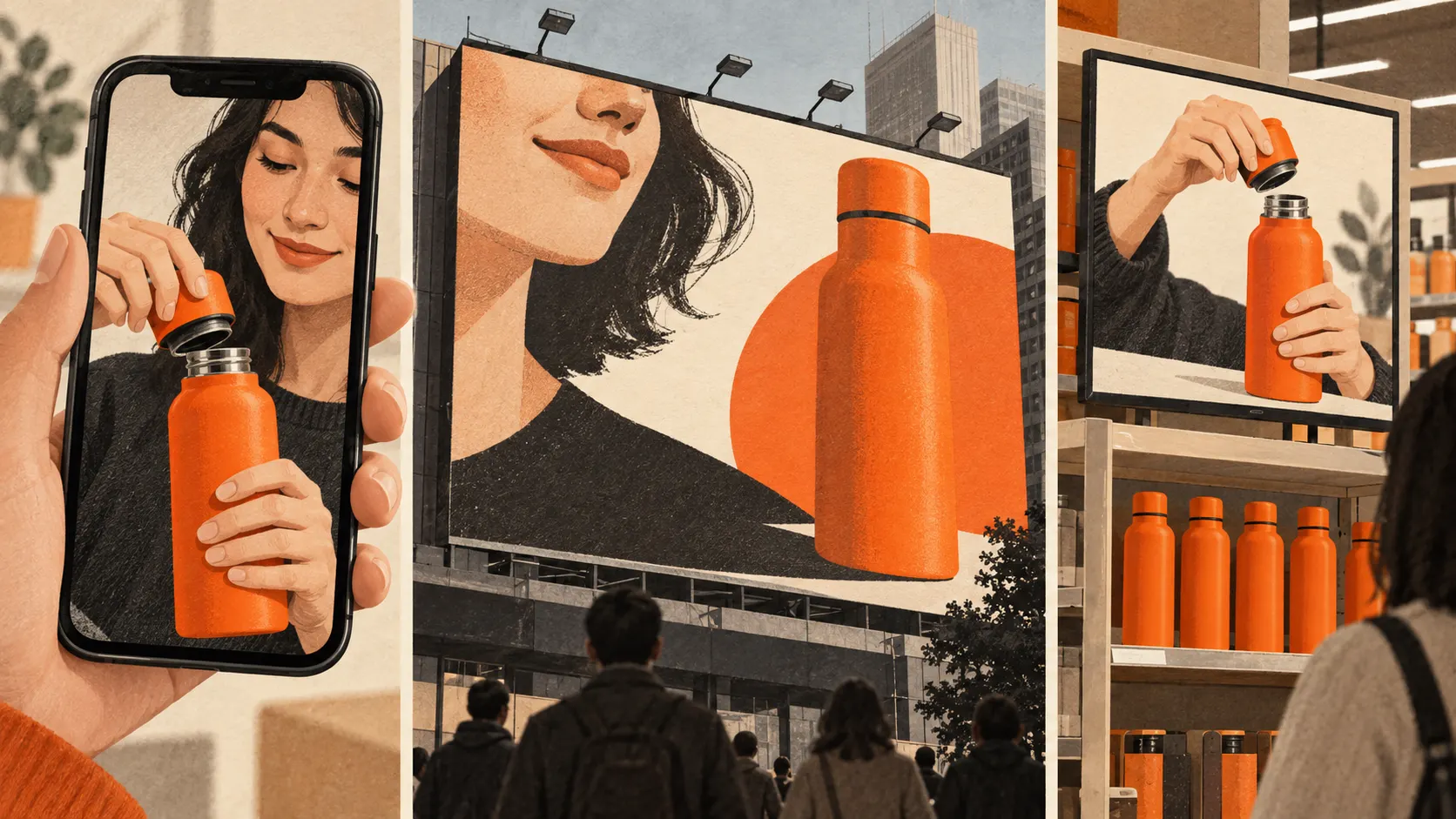
As a hypothetical example, consider a reusable-bottle demonstration. The mobile version might show the creator explaining the lid. A billboard edit could isolate the opening action and one legible benefit. A retail version might give more attention to the product detail a shopper can inspect nearby. The point is to choose what survives the change in distance and attention, rather than simply enlarge the original frame.
Choose a next step that exists in the placement. TikTok’s guidance suggests a simple route to a profile or branded landing page where appropriate. A QR code is another option to discuss for a suitable setting, not a default answer for every screen.
Test the destination on an ordinary phone: language, availability, product match and the steps someone must complete. Do not depict a shoppable-video button as though a passerby can tap it on the billboard. TikTok also requires review of concepts and final assets; local OOH requirements need their own check.
Out of Phone may contribute to a purchase journey, but the official material reviewed here does not establish automatic attribution from a physical-screen exposure to TikTok Shop gross merchandise value (GMV). A brand should agree how it will evaluate the campaign before buying the media.
This matters because several different questions can be hidden inside “did it work?” A campaign can deliver its booked placements, attract interest and record orders without establishing how many additional purchases it caused.
In TikTok’s Dove Men+Care case study, the brand combined on-platform advertising with Out of Phone in Amsterdam and Rotterdam. The measurement plan included TikTok Brand Lift, Kantar cross-media research and Circana Geolift.
Read the result in context: The case reports a 2.1% sales lift in the TikTok-only region and 3.1% in the region combining TikTok and Out of Phone. These are results from a Netherlands campaign, not TikTok Shop GMV figures or a forecast for another brand.
The arithmetic difference is one percentage point. The public case does not provide enough underlying detail to independently reproduce the study or turn that difference into a universal estimate of DOOH’s effect. Its useful lesson is that the comparison was built into the measurement approach.
An attributed order is assigned to a source under a defined tracking method. Incremental sales are the additional sales estimated to have occurred because of the campaign. Establishing the second requires a credible comparison with what would have happened without it.
The following framework can guide a discussion with the campaign and measurement partners. It is not a promise that each reporting option comes with every booking.
| Question | Evidence to request | What it cannot establish alone |
|---|---|---|
| Did the campaign run? | Delivery report and placement records | Whether an individual paid attention or bought |
| Did people respond? | Visits or scans through an agreed tracking route | The full effect of the campaign |
| Were orders recorded? | Defined order source, attribution window and treatment of returns | Whether those orders would have happened anyway |
| Did the campaign add sales? | A suitable control, holdout or geographic lift design | A guaranteed outcome in another market or campaign |

We recommend agreeing the comparison period, concurrent promotions, stock availability and companion media before launch. If TikTok advertising increases at the same time, the evaluation needs to account for that rather than credit every change to the screens.
Ask whether the proposed test can produce enough data to answer the business question. If it cannot support a useful sales-lift estimate, set a narrower objective and say what the result will leave unresolved. That is more useful than collecting an impressive-looking total with no clear interpretation.
A sensible test begins with a specific audience and decision. For example: does placing an adapted demonstration in selected locations add value alongside the brand’s existing activity? That is a question a campaign can be designed around. “Get our creators onto bigger screens” is a creative ambition that still needs a business purpose.
Our suggested readiness check is practical:
The reviewed onboarding guidance does not specify a minimum Shop GMV threshold. Assess the campaign’s purpose and practical readiness alongside company size.
If product availability is unreliable, rights are unresolved or the team cannot explain what it will learn, address those issues first. Stronger TikTok Shop operations and a more usable creator library may be the better immediate investment. That comparison should be made against the brand’s actual alternatives for the budget, including improvements to its existing creator program.
Bring the decision into one brief: the objective, audience and locations; proposed formats; selected assets and rights owner; intended destination; total budget; campaign dates; approval responsibilities; and measurement plan. Include the question the team will answer when the campaign ends.
At eCOMMop, UGC and affiliate marketing includes agreeing usage rights upfront and planning content for reuse across channels. If you are considering Out of Phone, start with a review of the creator assets you would want to use and the permissions each would need.
A growing library of creator videos gives a brand more material to consider. Its value on another screen depends on the work between selecting the video and placing it there. Talk to eCOMMop about your creator content and reuse plans, then take a clear objective and a better-defined set of assets into the media discussion.
Most agencies own a slice. The TikTok agency doesn't see your Amazon listing performance. Your Amazon manager doesn't know what's going viral on TikTok. Your Shopify CRO consultant doesn't see either.
We see all of it. Same team, same dashboards, same weekly review. When a TikTok video starts converting at 4×, we know to push that creative into Amazon Sponsored Brands and Shopify paid social — that same week. When Amazon shows a SKU running hot in Texas, we ramp creator seeding for that geo.
That's what "one engine" means in practice. One team. One dataset. One P&L view.