.svg)

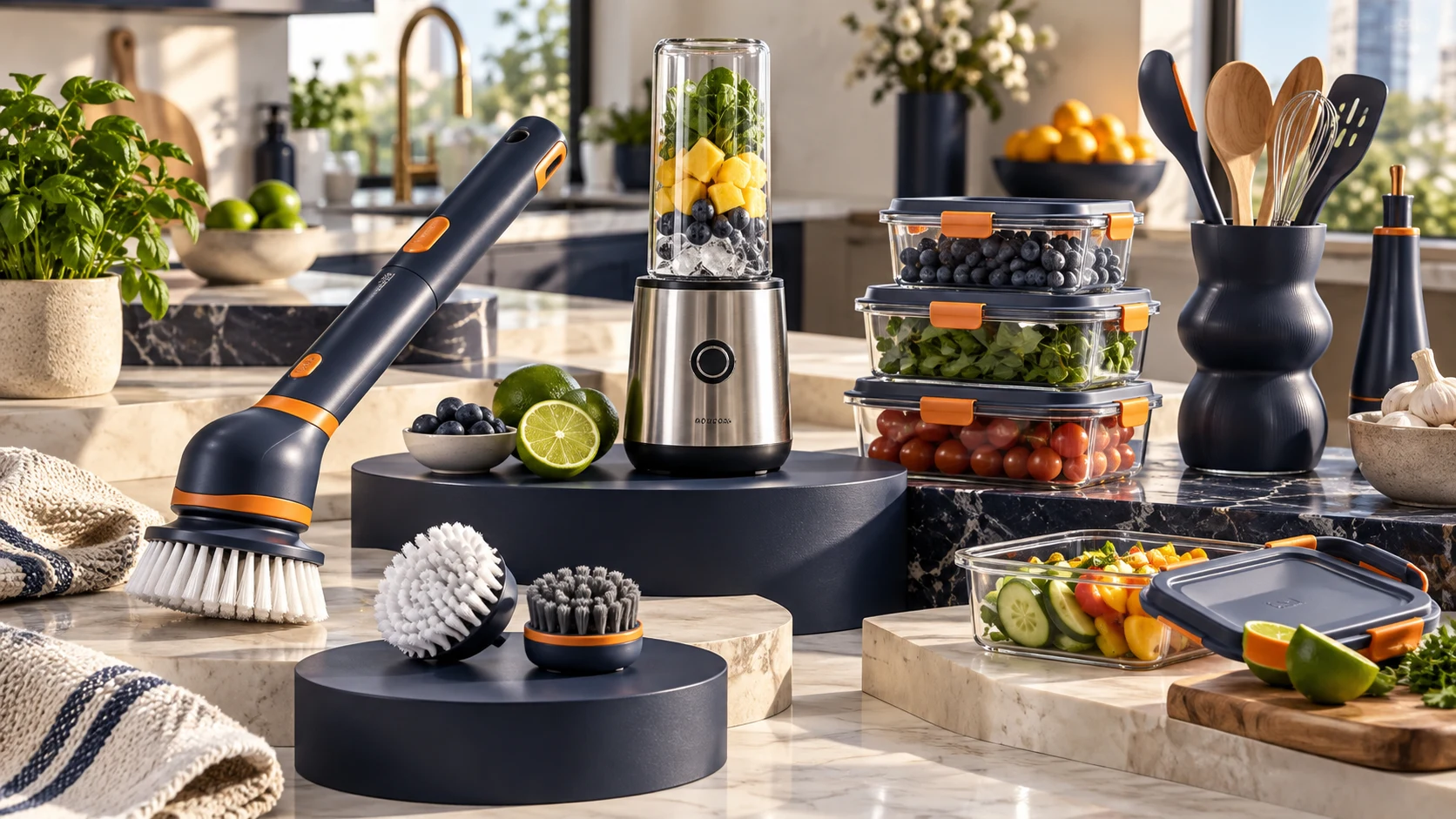
A cleaning brush has an immediate advantage on camera: viewers can see what changes when someone uses it. For TikTok Shop home and kitchen sellers, that connection between a familiar problem and a visible result is a useful starting point. A tidy drawer, a cleaned corner or a simpler food-preparation task gives the product a reason to appear in someone’s feed. This guide explains how to select products, brief creators, assess the margin and organise fulfilment around that opportunity. It is written for brands planning a launch or deciding which home products deserve another content test.
The short answer: Choose home and kitchen products whose usefulness is visible in a real demonstration. Match each product to a specific household problem, calculate the margin after creator and delivery costs, and test several credible creative angles. CleanTok attention is a starting point; profitable, fulfilled orders are the measure that matters.
CleanTok, CookingTok and OrganisationTok give sellers distinct contexts for showing the same home. Cleaning content can demonstrate removal, cooking content can show preparation, and organisation content can show how a space becomes easier to use. The useful connection is product-to-content fit: the product helps complete the activity viewers came to watch.
There is evidence of commercial activity around these communities. According to TikTok’s Spanish CleanTok report, published on 29 April 2026, two in three TikTok users buy cleaning products monthly. The report cites GWI research. It also reports that TikTok Shop represents 70% of KIMIA Hogar’s online sales. The article does not provide enough survey detail to treat the first figure as a US buying benchmark; the second is one brand’s channel mix. Both are signals worth investigating, rather than forecasts for a new seller.
Home products also compete with established categories for attention. Marketplace Pulse’s analysis of 18 June 2026 puts beauty and personal care at about 30% of tracked revenue in its sample of the top 1,000 US products by lifetime sales. That sample cannot establish a home and kitchen conversion rate. It does reinforce the need to earn attention with a specific product demonstration.
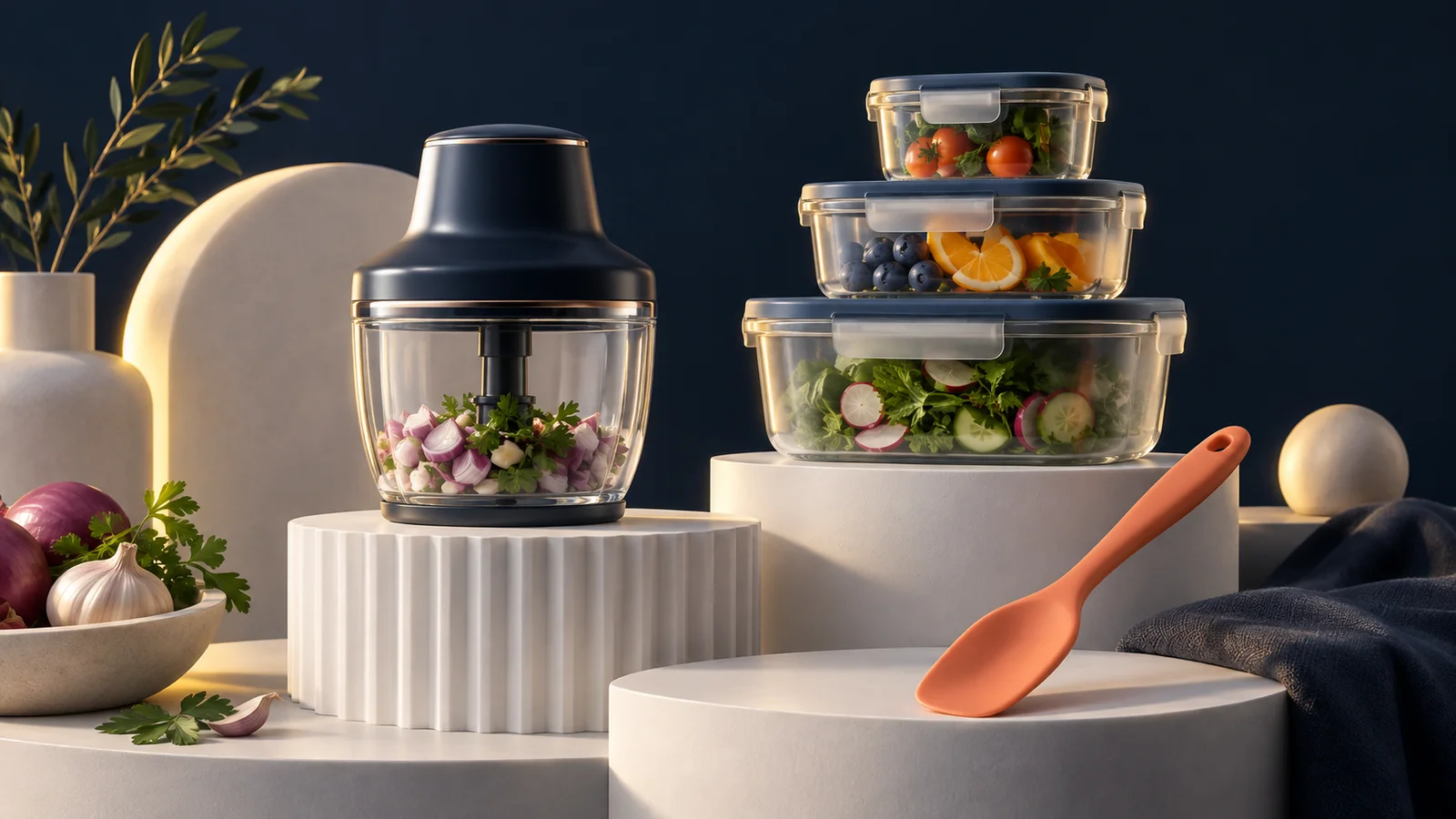
Cordless vacuums, steam mops and compact blenders have documented sales traction worth examining. The examples below show different kinds of demand evidence; they are not a single, comparable bestseller ranking.
For an initial test, shortlist 3 products with different demonstrations: cleaning a surface, preparing an ingredient and organising a drawer. That is a suggested research scope, not a sales benchmark. Score sample quality, packed dimensions and margin before deciding which deserves creator investment.
A useful conversion rate is one that produces enough contribution margin to support acquisition and operations. The available sources do not establish a reliable category-wide percentage for home products.
For an illustrative break-even calculation, assume each acquired product-page visit costs $0.20 and each order contributes $9.20 before advertising. Break-even conversion is $0.20 ÷ $9.20 = 2.17%. At 1,000 paid visits, 22 orders would contribute $202.40 against $200 in advertising, leaving just $2.40 before overhead. This is an economic floor under those assumptions, not a recommended target.
Keep the denominator consistent. Orders divided by product-page visits describes a different stage from orders divided by video views. Compare the same product, traffic source and reporting window, then inspect refunds alongside orders. For broader diagnosis, use our guide to turning TikTok Shop views into sales.
A low selling price can make a product easier to trial, while leaving little room for postage, creator commission and replacements. A higher-priced product needs more convincing proof. Price and margin need to be tested together.
The Marketplace Pulse sample above has a median top-product price of about $40, with roughly two-thirds below $50. This is a description of that sample across categories. It does not prove a conversion threshold at $40 or make a higher-priced appliance unsuitable.
Start with the product’s actual cost stack. TikTok’s US category referral-fee schedule, dated 14 May 2026, lists 6% for Kitchen Utensils & Gadgets, Home Care Supplies and Home Organizers. Confirm the applicable category and account terms before setting your offer.
For a simplified illustrative $30 order, assume no discounts, taxes or shipping charges collected from the buyer:
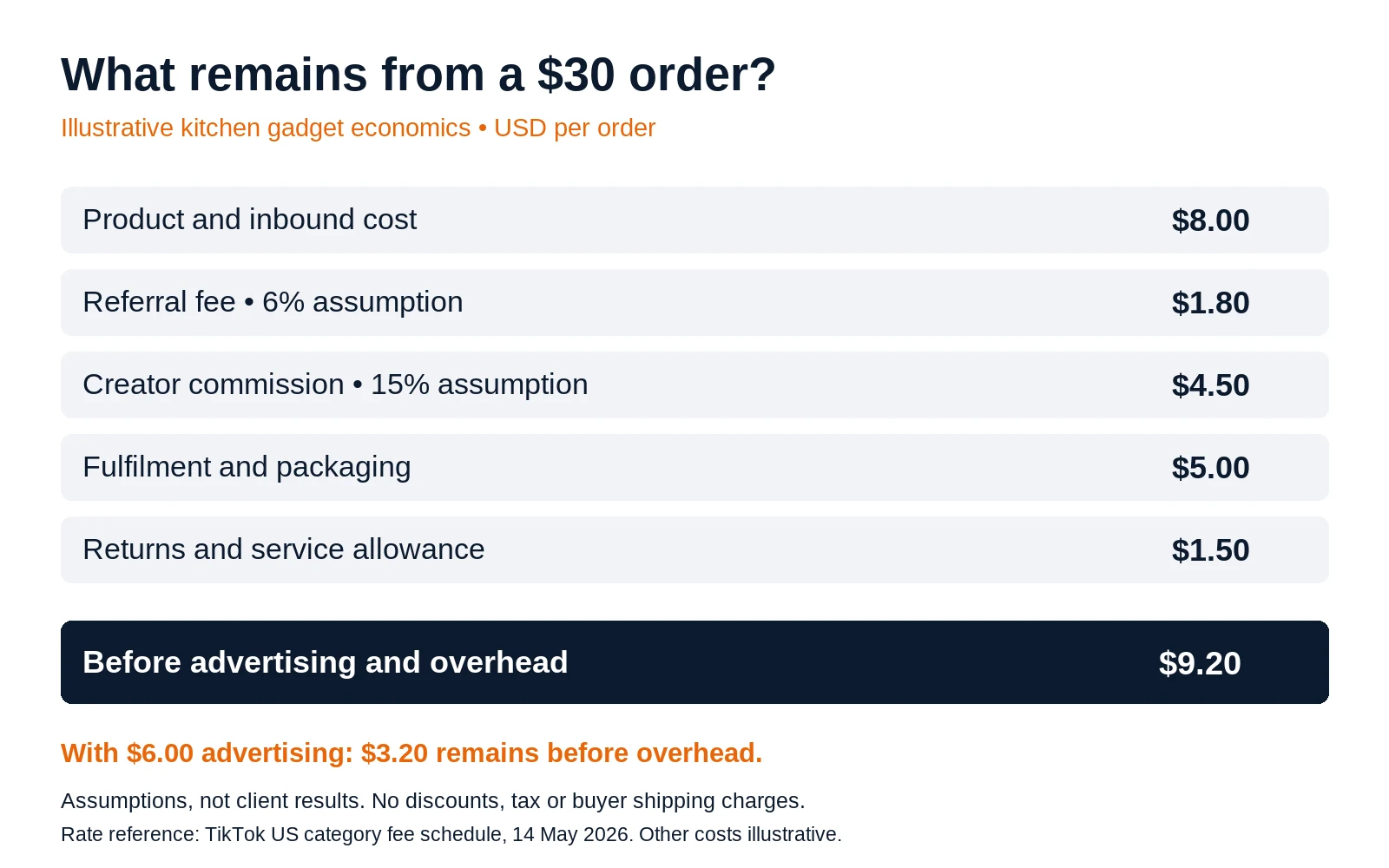
Illustrative calculation, not an eCOMMop client result or a platform quotation. Only the referral-rate assumption references the category fee schedule; replace every cost with your own figures.
If the same order requires $6 in advertising, the remaining contribution falls to $3.20 before overhead. A higher return allowance or a bulky parcel can reduce it further. Use net settlement data when reconciling real orders, including discounts, programme charges and refund adjustments where applicable.
Test a single product and a useful bundle separately. A bundle should solve a coherent task, such as cleaning several compatible surfaces, and its extra weight must fit the economics. Increasing order value alone does not establish that the offer is better.
If your product attracts views but the numbers do not work, ask eCOMMop for a category lever review. We can assess the offer, creator approach and fulfilment plan together.
A useful creative test begins with the household task. “Promote this organiser” leaves the creator to invent both the problem and the proof. “Show whether it makes this crowded drawer easier to use” gives the video something concrete to resolve.
Storage products can struggle when viewers cannot judge fit, capacity or practical improvement from the video. A neat final image may attract attention without answering whether the item works in their own cupboard.
Show the space before use, the items going inside and the result from the same angle. Include dimensions and installation requirements on the product page. For an under-sink organiser, the location of pipes may matter more to purchase confidence than another polished close-up.
Make the test measurable: brief 3 creators on 2 angles each, producing 6 videos that compare a satisfying transformation with a practical fit demonstration. This is a suggested test design. Hold price and the landing page consistent, then compare product clicks, orders and fit-related questions; six videos alone do not establish statistical certainty.
Kitchen gadgets can attract sharing when the demonstration makes an everyday task look noticeably easier or unusually satisfying. That is a creative opportunity, not a guarantee of reach or sales.
The sound of a clean cut or a well-fitted lid can support an ASMR-style video. For pacing, TikTok’s 2025 Home & Living playbook suggests a room-reveal structure with a 3–5-second opening, 10–20-second middle and 3–5-second close. Adapt that structure to the kitchen task while keeping preparation and clean-up visible. These are creative guidelines, not promised viral-performance thresholds.
Searches for “best kitchen gadgets 2026”, “viral kitchen gadgets” and “Amazon home finds TikTok” can inspire research. Build a 5-product research list from the types below, informed by the sales examples above. Record each candidate’s current price, 30-day sales where available and packed weight; do not mix lifetime sales counters with monthly figures.
A named search such as “Homeika cordless vacuum” is a product-research lead, not evidence that another vacuum will sell similarly. Evaluate the exact model and offer. For private-label products, use product sourcing support to assess samples, packaging and supply consistency before building a campaign around them.

Brief creators on one household problem, the evidence needed to demonstrate the result and the limitations they must explain. Leave room for their own voice and home environment.
Use this sequence for an initial creative test:
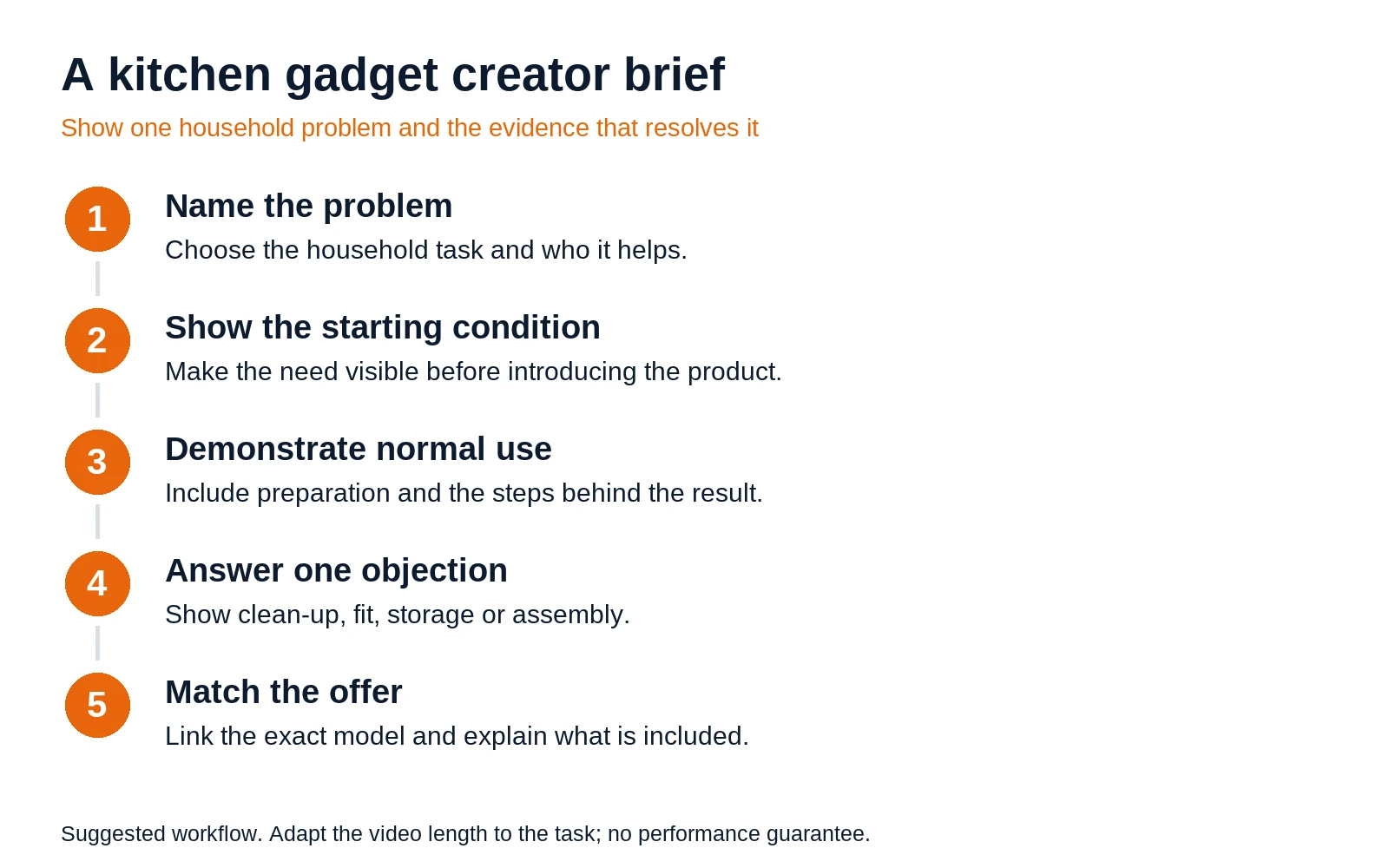
Suggested creative sequence. Adapt the duration to the task; this is not a platform rule or a performance benchmark.
For the six-video test above, ask each creator for a 15-second cut and a 30-second cut, giving 12 edits from 6 concepts. These are suggested production lengths. Keep essential context in both; compare product clicks and orders alongside video completion, rather than selecting the shortest edit automatically.
According to NIQ’s German TikTok Shop report of 24 March 2026, home and appliances represented 14% of revenue, behind fashion at 17% and computers/electronics at 16%. The report covers 31 March 2025–1 March 2026 using NIQ’s German e-commerce panel. These figures describe Germany’s category mix, not US demand or a home-product conversion rate.
For the UK, the blender and steam-mop growth figures above offer product-level signals, but their methodology differs from NIQ’s revenue shares. Test localisation within each market: use 2 angles across 2 countries to create 4 test cells. Use local-language creators, relevant dimensions and local delivery details. The suggested structure tests preferences rather than assuming them.
For example, an organiser demonstration can emphasise the completed cupboard in one version and fitting around an obstruction in another. Both should include accurate dimensions. Review our TikTok Shop Germany market overview for wider context, then validate the product opportunity using local demand and operating costs.
Fulfilment becomes part of the offer when shoppers assess the delivery promise. For home products, packed dimensions, fragility and replacements deserve attention before a successful video increases demand.

Fulfilled by TikTok is not presented as a universal requirement for selling home products in TikTok’s current US logistics overview. The page, checked on 15 September 2026, describes three options, with eligibility conditions:
The overview does not establish an FBT requirement for orders below $25. Confirm the options enabled for your account and meet the applicable fulfilment requirements.
The same overview lists a $6.92 single-unit fulfilment fee for the 3–4 lb band, compared with $4.70 for 8–12 oz. That $2.22 difference is material against a $30 selling price. Confirm actual and dimensional-weight treatment for your package; these fulfilment fees are not all-in logistics costs.
For the product decision, compare the full cost of each eligible option using the same packed item and order profile. Include storage, inbound transport, dispatch handling and potential returns. A compact brush and a large organiser can have very different costs even at the same selling price. Our guide to TikTok Shop partner and fulfilment terms explains the roles behind the acronyms.
A successful video identifies a product and demonstration worth testing again. Fresh creative can matter: in TikTok’s Mira’s Kitchen case study, the South Korean kitchenware brand’s campaigns using refreshed AI-generated ads recorded 3.5 times the conversion rate and 60% lower cost per action than campaigns without them during 1–31 August 2025. This is an advertiser case comparison, not a US TikTok Shop benchmark or a controlled estimate of creative impact.
There is no verified fixed sales lifespan in the reviewed sources. Use 7-day reporting windows as a suggested monitoring cadence. For example, 40 orders in one week and 25 the next is a 37.5% decline. That illustrative change should trigger checks of traffic, stock, price and creative before attributing it to fatigue.
Prepare the next brief while useful demand signals are still available. Turn repeated buyer questions into demonstrations: how the chopper cleans, what the organiser fits or how the scrubber reaches an awkward area. Each new angle should answer a genuine uncertainty.
Set creator sample volumes around your budget and ability to assess the resulting content. Track samples sent, content produced, sales and costs by creator where attribution allows. A large creator roster has limited value if the product promise, stock position or margin remains unresolved.
Home and kitchen brands have practical material for TikTok content: tasks people recognise and results they can inspect. Before committing to a larger launch:
If you are choosing a first product or reviewing an existing shop, get in touch with eCOMMop for a category lever review. Bring the product, current costs and available content results so the next test addresses a specific commercial question.
Most agencies own a slice. The TikTok agency doesn't see your Amazon listing performance. Your Amazon manager doesn't know what's going viral on TikTok. Your Shopify CRO consultant doesn't see either.
We see all of it. Same team, same dashboards, same weekly review. When a TikTok video starts converting at 4×, we know to push that creative into Amazon Sponsored Brands and Shopify paid social — that same week. When Amazon shows a SKU running hot in Texas, we ramp creator seeding for that geo.
That's what "one engine" means in practice. One team. One dataset. One P&L view.